
Personal Loan Interest Rates Explained: What Affects Your Rate and How to Get the Best Deal
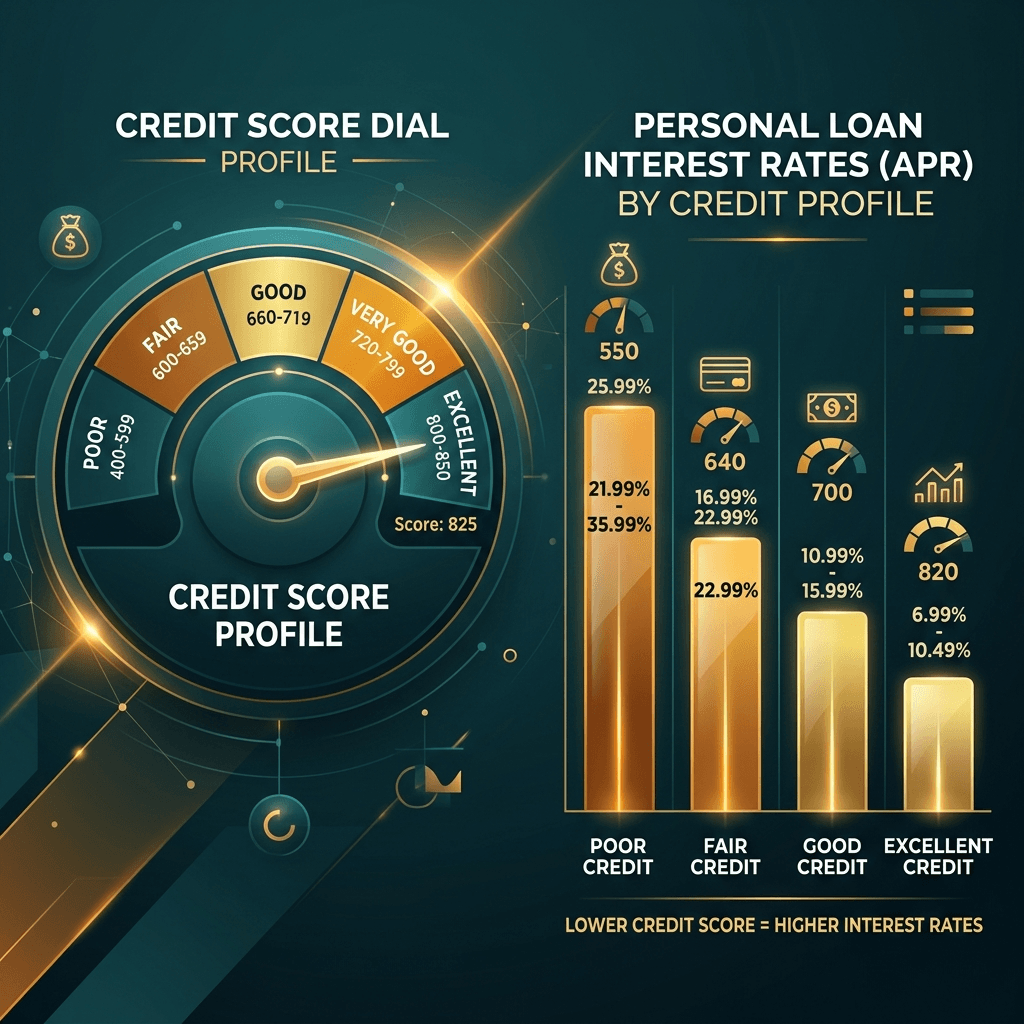
Two borrowers apply for the same $15,000 personal loan at the same bank on the same day. One is offered 8.5% APR. The other is offered 24% APR. Over a 3-year term, that difference costs the second borrower over $4,000 more in interest - for identical money.
Personal loan interest rates are not random. They're calculated based on specific factors, most of which you can influence. Understanding how lenders price risk is the first step toward getting a rate that doesn't quietly drain your finances.
This guide explains how personal loan interest rates work, what drives them up or down, and the concrete steps you can take to qualify for the best available rate.
What Is a Personal Loan Interest Rate?
A personal loan interest rate is the cost of borrowing money, expressed as a percentage of the outstanding principal per year. It determines how much extra you repay above the amount you borrowed.
There are two key figures to understand:
Always compare APR across lenders, not just the headline interest rate. A loan at 10% interest with a 2% origination fee has a higher true cost than a loan at 10.5% interest with no fees on shorter tenures.
Personal loans are typically unsecured - meaning no collateral is required. Because lenders carry more risk than on secured loans (mortgages, car loans), personal loan rates are generally higher.
According to the Federal Reserve (2025), the average personal loan interest rate in the United States was 12.35% APR for a 24-month personal loan across all credit profiles. However, rates for well-qualified borrowers at competitive lenders routinely range from 6.5% to 9%.
What Affects Your Personal Loan Interest Rate - Step by Step
Lenders don't set your rate arbitrarily. They run your application through a risk model that considers several specific factors. Here's what each one means and how it affects your rate.
Step 1: Credit score - the single biggest factor
Your credit score (FICO in the US, credit file score in the UK and Australia) is the primary driver of your interest rate. Lenders use it to predict the statistical likelihood that you'll repay the loan.
Improving your score by even 50 points before applying can save thousands over the loan term.
Step 2: Debt-to-income (DTI) ratio
Lenders calculate your total monthly debt obligations (all existing EMIs and minimum payments) as a percentage of your gross monthly income. A DTI below 35% is considered healthy; above 50% makes approval difficult at competitive rates.
Step 3: Employment and income stability
Salaried employees at established companies present lower risk than self-employed applicants with variable income. Lenders look for at least 1-2 years of continuous employment, or 2-3 years of documented self-employment income.
Step 4: Loan amount and tenure
Longer tenures carry more uncertainty - and therefore higher rates on some products. Smaller loan amounts may also attract slightly higher rates, as fixed administrative costs represent a larger proportion of the loan.
Step 5: Lender type
Banks, credit unions, and online lenders price risk differently. Credit unions - member-owned, not-for-profit institutions - routinely offer rates 1-3% lower than commercial banks for equivalent borrowers. Online lenders vary enormously; some are highly competitive, others predatory.
→ Use our free EMI Calculator to see exactly how a 1-2% difference in rate affects your monthly payment and total interest cost - no sign-up needed.
Step 6: Relationship with the lender
Existing customers at a bank or credit union often receive preferential rates. If you have a savings account, current account, or previous loan at an institution that you've managed well, ask specifically about loyalty pricing before applying elsewhere.
Personal Loan Rate Example: The Real Cost of a Higher Rate
Loan amount: $15,000 | Tenure: 3 years (36 months)
| Credit Profile | APR | Monthly EMI | Total Repayment | Total Interest |
|---|---|---|---|---|
| Excellent (750+) | 7.5% | $466 | $16,776 | $1,776 |
| Good (700-749) | 12% | $498 | $17,928 | $2,928 |
| Fair (650-699) | 18% | $542 | $19,512 | $4,512 |
| Poor (below 650) | 28% | $613 | $22,068 | $7,068 |
| Subprime / high-risk | 36% | $682 | $24,552 | $9,552 |
The difference between an excellent and a poor credit profile on a $15,000 loan: $7,776 in additional interest over 3 years - on the same principal amount.
Personal Loan Rates by the Numbers
| Country | Average Personal Loan APR (2025) | Low-end (excellent credit) | High-end (poor credit) |
|---|---|---|---|
| United States | 12.35% | 6.5% | 36% |
| United Kingdom | 9.4% | 5.8% | 29.9% |
| Australia | 11.2% | 6.9% | 26.95% |
| Canada | 10.8% | 7.2% | 32% |
| India | 14.5% | 10.5% | 30% |
*Sources: Federal Reserve (US, 2025), Bank of England (UK, 2025), RBA (Australia, 2025). Rates are indicative averages and vary by lender.*
Common Mistakes to Avoid
Accepting the first offer
The single most expensive mistake. Personal loan rates vary enormously across lenders - often by 5-10 percentage points for the same borrower profile. Always get at least three quotes before accepting. Use pre-qualification tools (which use soft credit checks that don't affect your score) to shop without risk.
Applying to multiple lenders without using pre-qualification
Hard credit inquiries - triggered when lenders formally check your credit for a loan application - each reduce your score by a few points. Multiple hard inquiries in a short window signal desperation to lenders. Use pre-qualification tools that run soft checks instead.
Choosing the longest tenure to minimise EMI
A 5-year personal loan at 14% APR versus a 3-year loan at the same rate doubles your total interest cost. Borrow only what you need and repay it as fast as your budget comfortably allows.
Ignoring origination fees
A lender advertising 8.5% interest with a 3% origination fee on a $10,000 loan is charging $300 upfront - which effectively raises your true borrowing cost. Factor origination fees into your APR comparison.
Borrowing to fund lifestyle rather than genuine needs
Personal loans are appropriate for debt consolidation, emergency expenses, home repairs, and education. Using a 14-20% APR personal loan to fund holidays, electronics, or discretionary spending is one of the most expensive ways to finance consumption.
The Bottom Line
Your personal loan interest rate is not fixed by fate - it's priced by risk factors you can directly influence. A better credit score, lower existing debt, and smart lender selection can cut your rate by 5-10 percentage points, saving thousands over the loan term.
Before you commit to any loan offer, calculate the full cost - not just the monthly payment.
Our free EMI Calculator gives you the answer in under 30 seconds - compare how different rates change your total repayment.
Use our free EMI Calculator to apply what you have learned.
Open EMI Calculator →