
How Compound Interest Works - and Why It's the Most Powerful Force in Personal Finance
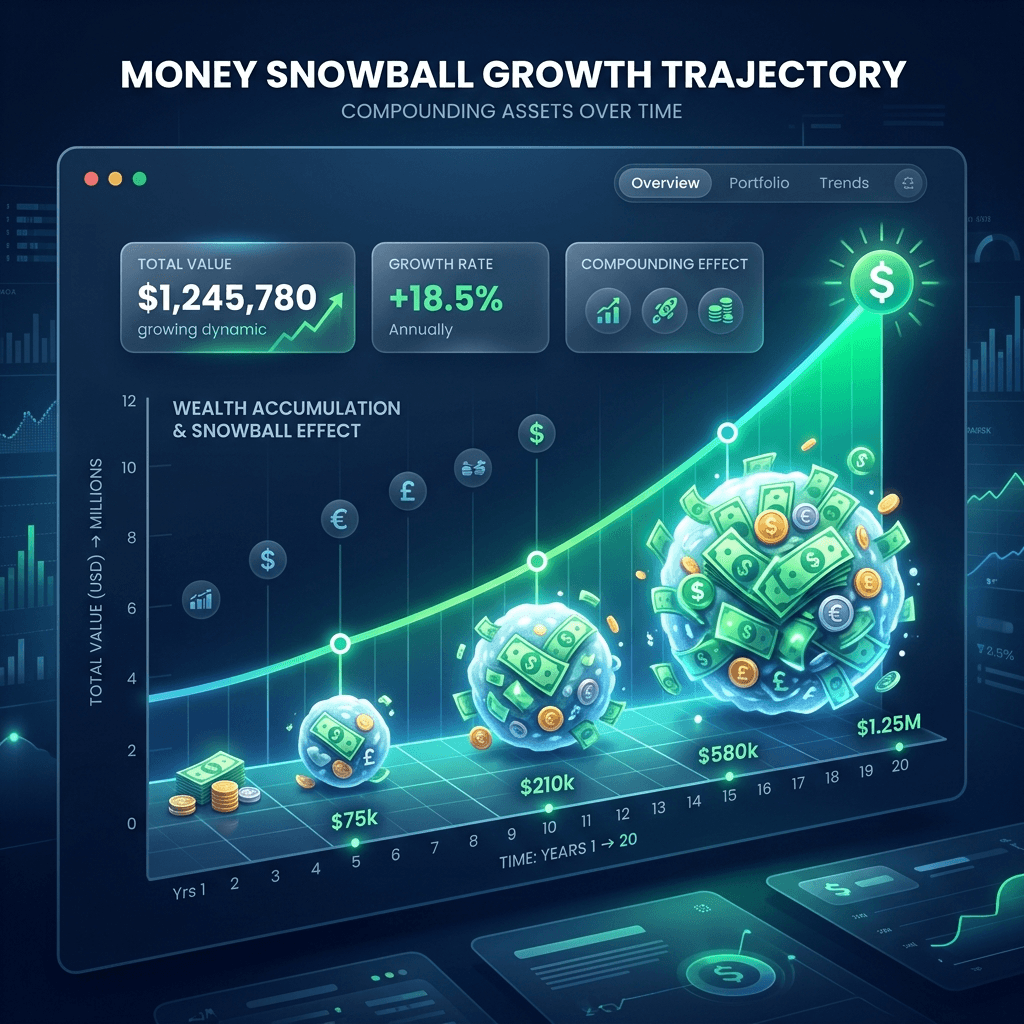
Albert Einstein allegedly called compound interest the "eighth wonder of the world." Whether he actually said it or not, the sentiment holds up. Compound interest is the single most important concept in personal finance - and yet most people only have a vague idea of how it works.
If you've ever looked at your savings account balance after a year and thought "that's all it grew by?" - this post is for you. By the end, you'll understand exactly how compound interest works, how to calculate it yourself, and why the timing of your money matters far more than the amount.
What Is Compound Interest?
Compound interest is interest calculated on both your original deposit (the principal) and the interest you've already earned. In other words, your interest earns interest.
This is fundamentally different from simple interest, which only ever calculates growth on your starting amount. With simple interest, $10,000 at 5% per year earns $500 every year - full stop. With compound interest, that first year's $500 gets added to your principal, so year two you're earning interest on $10,500. Year three, you're earning on $11,025. And it keeps snowballing from there.
The longer your money compounds, the faster it accelerates. This is the core mechanic behind wealth-building - and it's why financial advisors so consistently push people to start saving early. Time is the ingredient that makes compounding genuinely extraordinary.
According to the Federal Reserve (2025), the median US household holds roughly $8,000 in transaction accounts. Understanding how to grow that money - and how compounding amplifies it - can make a material difference over a lifetime.
How to Calculate Compound Interest - Step by Step
The compound interest formula looks intimidating at first glance, but it's straightforward once you break it down.
The formula:
A = P (1 + r/n)^(nt)
Where:
Step 1 - Identify your inputs. Say you deposit $5,000 into a high-yield savings account at 4.5% annual interest, compounded monthly, for 10 years.
Step 2 - Divide the rate by compounding periods. r/n = 0.045 / 12 = 0.00375
Step 3 - Calculate the exponent. n × t = 12 × 10 = 120
Step 4 - Apply the formula. A = 5,000 × (1 + 0.00375)^120 A = 5,000 × (1.00375)^120 A = 5,000 × 1.5669 A = $7,834.50
You deposited $5,000 and walked away with $7,834 - earning $2,834 in interest without doing anything additional.
Step 5 - Isolate the compound interest earned. Compound interest = A − P = $7,834.50 − $5,000 = $2,834.50
→ Use our free Compound Interest Calculator at GlobalUtilityHub to run these numbers instantly - no sign-up needed.
Compounding frequency matters more than most people realise. The more frequently interest compounds, the more you earn. The same $5,000 at 4.5% for 10 years:
The difference between annual and daily compounding on this example is about $75 - not huge on its own, but it scales significantly with larger principals and longer timeframes.
Compound Interest Example: How $3,000 Became $18,000
Let's follow a real scenario. In 2006, Jamie - a 25-year-old in Toronto - opened an investment account with $3,000 and added $100 per month. The account earned an average annual return of 7%, compounded monthly (a realistic long-run average for a balanced index fund portfolio, based on S&P 500 historical data).
By 2026, 20 years later, Jamie's account looks like this:
Jamie earned more from compounding than from actual deposits. The interest generated almost matches the total amount put in. That's compound interest doing its job over two decades.
Now flip it. Suppose Jamie had waited until age 35 to start - the same deposits, the same rate, but only 10 years instead of 20. The final value would be roughly $17,400. That 10-year delay cost Jamie over $41,000 in final value - even though the total deposits only differed by $12,000.
This is why the financial planning community is so relentless about starting early. The compounding curve is not linear - it bends upward sharply in the later years. Every year you delay represents not just one year's growth, but every year of compounding that would have built on top of it.
Compound Interest by the Numbers
| Starting amount | Annual rate | Compounding | Time | Final value | Interest earned |
|---|---|---|---|---|---|
| $1,000 | 3% | Monthly | 10 years | $1,349.83 | $349.83 |
| $5,000 | 4.5% | Monthly | 10 years | $7,834.50 | $2,834.50 |
| $10,000 | 5% | Monthly | 20 years | $27,126.40 | $17,126.40 |
| $10,000 | 7% | Monthly | 30 years | $81,499.90 | $71,499.90 |
| $20,000 | 6% | Daily | 25 years | $88,324.60 | $68,324.60 |
| $500/mo added | 7% | Monthly | 20 years | $131,900.00 | $11,900 gain on contributions |
*All calculations assume no withdrawals. Rates are illustrative - actual investment returns vary.*
Common Mistakes to Avoid
Waiting too long to start.
This is by far the most expensive mistake. A 22-year-old who saves $200/month at 6% will have significantly more at 65 than a 32-year-old doing the same - even though the 32-year-old has higher income and arguably more discipline. Time in the market matters more than the size of the contribution.
Confusing APR with APY.
Annual Percentage Rate (APR) is the nominal rate. Annual Percentage Yield (APY) accounts for compounding within the year. A savings account advertising 5% APR compounded monthly actually delivers 5.12% APY. Always compare APY when shopping for savings accounts or CDs - it's the number that reflects what you actually earn.
Withdrawing interest instead of letting it compound.
Some accounts let you withdraw earned interest. If you do this, you're converting compound interest back into simple interest. Leave the interest in place. Let it compound. That's the whole mechanism.
Ignoring fees.
A 1% annual management fee on an investment account might sound trivial, but it reduces your effective return substantially over time. On a $50,000 portfolio growing at 7% over 20 years, a 1% fee costs you roughly $30,000 in lost compounding. Low-cost index funds exist for this reason.
Applying the same logic to debt.
Compound interest works against you just as powerfully when you carry high-interest debt. A credit card charging 22% APR compounds your balance the same way a savings account grows your deposits - except it's working against you every month you carry a balance.
The Bottom Line
Compound interest is simple in concept and staggering in effect. Your money earns interest, that interest earns more interest, and over years and decades the curve bends sharply upward. The most important variable isn't the rate - it's time. Every year you delay starting costs you compounding that can never be recovered.
Use our free Compound Interest Calculator to apply what you have learned.
Open Compound Interest Calculator →