
Compound Interest vs Simple Interest: Which One Actually Earns You More?
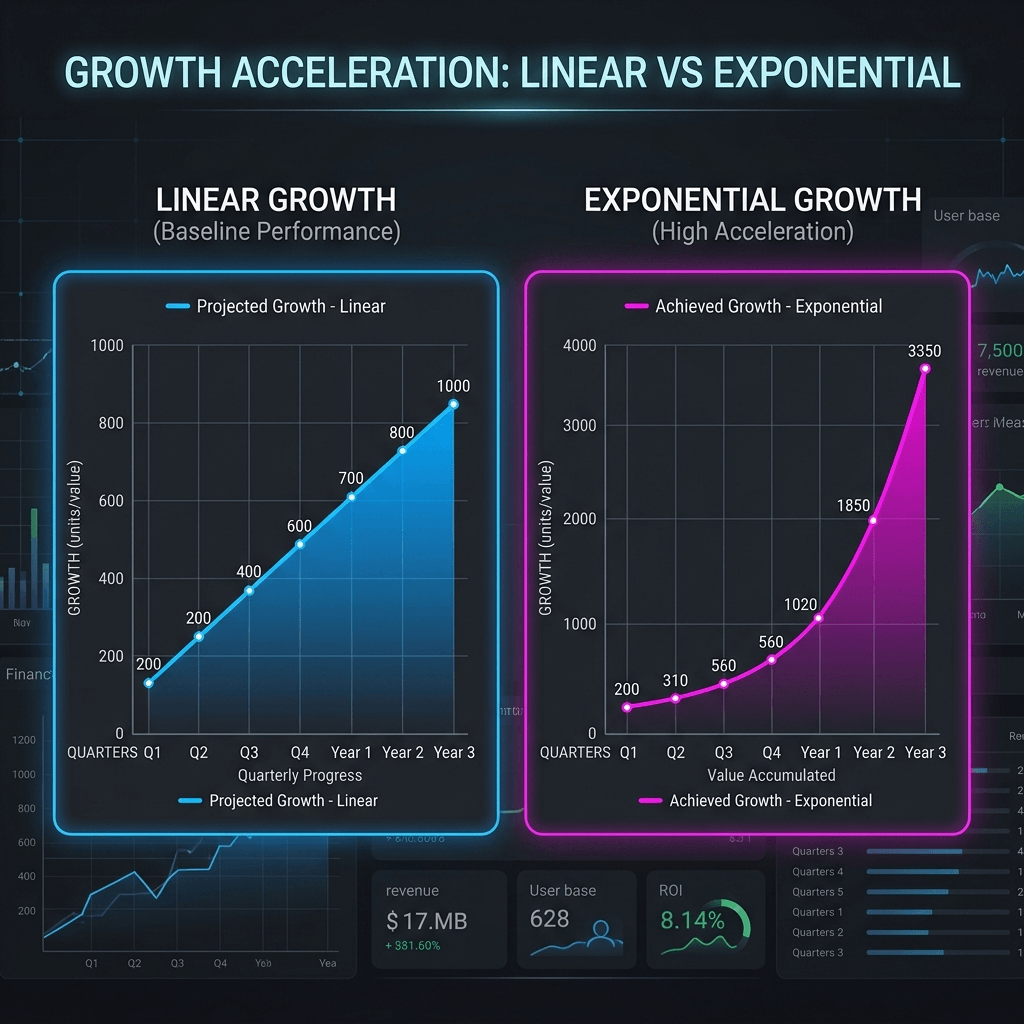
If you've ever opened a savings account, taken out a loan, or invested in a bond, you've dealt with one of these two types of interest - whether you knew it or not.
Simple interest and compound interest are both ways of calculating how money grows (or how debt accumulates). They sound similar. They start the same. But over time, they produce dramatically different results - and understanding which one applies to your money is one of the most useful things you can know.
This guide breaks down both types clearly, shows you the formulas, walks through real examples side by side, and explains when each type works in your favour - and when it doesn't.
What Is Simple Interest?
Simple interest is calculated only on the original principal - the amount you deposited or borrowed. It doesn't factor in any interest you've already earned. Every year, the interest payment is the same flat amount.
Simple interest formula:
Where:
Example:
You deposit $10,000 at 5% simple interest for 5 years.
Total balance after 5 years: $12,500
Every year, you earn exactly $500. In year one. In year five. In year twenty. The growth is perfectly linear - and that's precisely its limitation.
Simple interest is most commonly found in short-term personal loans, auto loans, and some government bonds. It's straightforward to calculate and easy to understand, which is why lenders sometimes prefer it - the interest you owe is predictable and fixed.
What Is Compound Interest?
Compound interest is calculated on the principal plus all previously earned interest. Your interest earns interest. Each period, the base amount grows, so the interest payment grows with it.
Compound interest formula:
Where:
Same example, now with compound interest:
$10,000 at 5% compounded annually for 5 years.
Versus the $12,500 from simple interest - a difference of $262.82 after just 5 years.
At first glance, $263 doesn't seem like a big deal. Stretch that out to 20 years, and the gap tells a very different story.
Side-by-Side Example: $10,000 Over 20 Years at 5%
Let's track the same $10,000 deposit at 5% annually under both systems.
Total: $20,000
Total interest earned: $16,532.98
The compound interest account produces $6,533 more - on the same starting deposit, at the same rate, over the same time. No additional contributions. No extra effort. Just the mechanics of compounding.
Now extend to 30 years:
The gap widens to over $18,000. This is the compounding curve at work - slow and steady in early years, then dramatically accelerating as the interest base grows larger.
According to the Consumer Financial Protection Bureau (2025), most Americans aren't aware of the difference between simple and compound interest when evaluating savings accounts - a gap in financial literacy that costs real money over decades.
Compound Interest vs Simple Interest by the Numbers
| Scenario | Rate | Time | Simple Interest Total | Compound Interest Total | Difference |
|---|---|---|---|---|---|
| $5,000 | 4% | 5 years | $6,000 | $6,083.26 | $83.26 |
| $5,000 | 4% | 10 years | $7,000 | $7,401.22 | $401.22 |
| $10,000 | 5% | 10 years | $15,000 | $16,288.95 | $1,288.95 |
| $10,000 | 5% | 20 years | $20,000 | $26,532.98 | $6,532.98 |
| $20,000 | 6% | 15 years | $38,000 | $47,954.04 | $9,954.04 |
| $20,000 | 6% | 30 years | $56,000 | $114,869.84 | $58,869.84 |
*All figures assume annual compounding and no additional contributions. Results are for illustration.*
The pattern is unmistakeable: the advantage of compound interest grows non-linearly with time. At 5 years, the difference is modest. At 20-30 years, it's transformative.
Common Mistakes to Avoid
Assuming all accounts work the same way.
Many people assume their bank accounts, bonds, and loans all use the same interest calculation. They don't. High-yield savings accounts typically compound daily or monthly. Many personal loans use simple interest. US Treasury bills use simple interest. Credit cards use compound interest - and that's very much not in your favour when you carry a balance.
Underestimating the long-term gap.
Because the compound vs simple difference is small in early years, people often dismiss it. The compounding benefit is backend-heavy - the real divergence happens in years 15, 20, and beyond. Don't judge compounding on a short timeframe.
Ignoring debt context.
Most people think about compound interest only in terms of saving and investing. But on the debt side, compound interest is the engine driving credit card balances out of control. A $3,000 credit card balance at 22% APR, compounded monthly, grows to over $4,200 in just two years if no payments are made - a 40% increase. Simple interest on the same balance would total $3,000 + $1,320 = $4,320, so the gap is smaller on credit cards, but compound interest still accelerates the damage.
Confusing APR and APY.
When a bank advertises 5% APR compounded monthly, the actual Annual Percentage Yield (APY) is 5.12%. This matters when comparing accounts - always compare APY to APY. The APY reflects what compound interest actually delivers, and it's always slightly higher than APR for accounts that compound more than once a year.
Withdrawing earned interest.
If you have the option to receive interest as a payout rather than reinvest it, you're opting out of compounding. You're effectively converting your account to simple interest. Reinvesting interest - keeping it in the account to compound - is essential to experiencing the full benefit.
The Bottom Line
Simple interest is predictable and linear. Compound interest is exponential and powerful. For savings and investments, compound interest is what you want - and the longer your time horizon, the more dramatic the advantage becomes.
The difference between the two isn't just mathematical. It's the difference between saving $20,000 over 20 years and saving $26,500 - with the same starting amount, the same rate, and zero extra effort. The mechanism is the variable.
Use our free Compound Interest Calculator to apply what you have learned.
Open Compound Interest Calculator →