
The Complete Car Loan Guide: How to Finance a Vehicle Without Overpaying
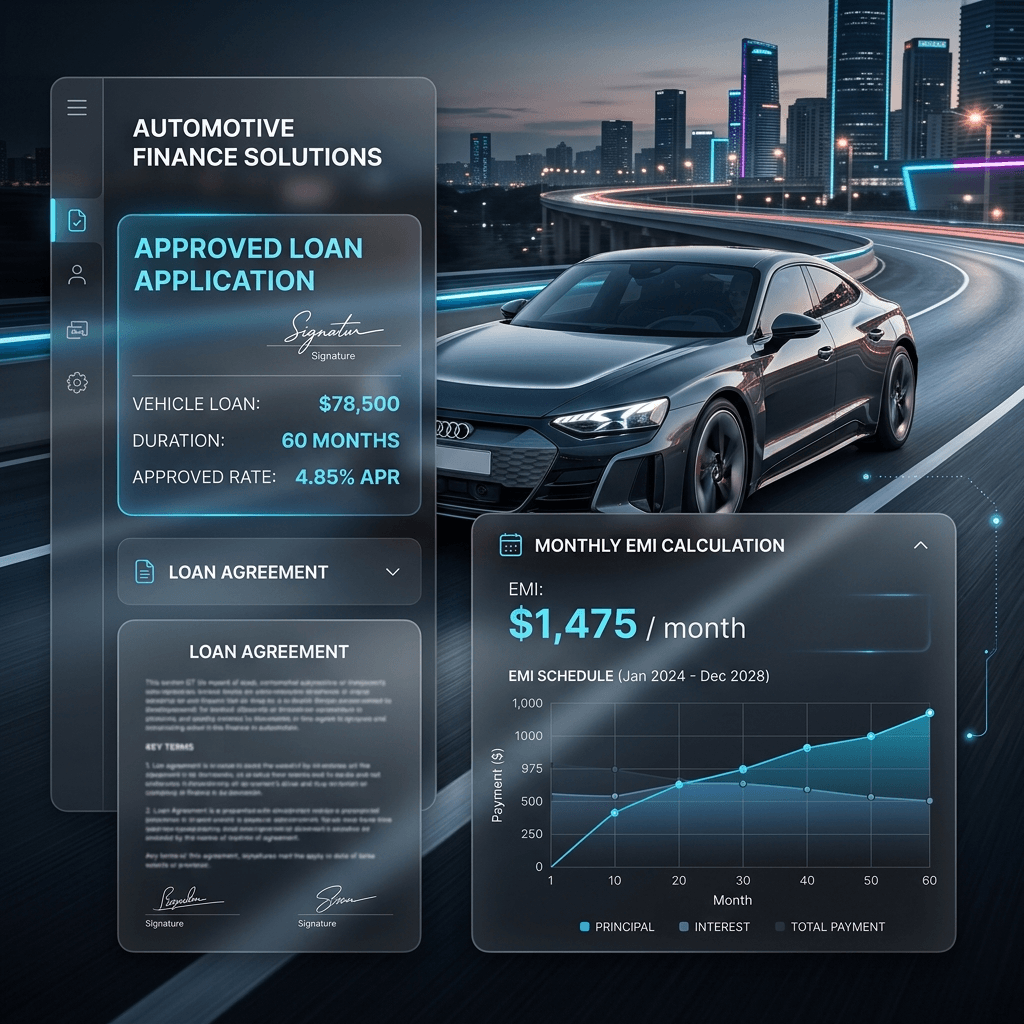
Buying a car is one of the largest financial decisions most people make - and financing it incorrectly is one of the easiest ways to overpay by thousands of dollars without realising it. The sticker price is just the beginning. Add a high interest rate, a stretched tenure, and a few dealer add-ons, and a $28,000 car can end up costing $38,000 by the time you've made the final payment.
This guide explains how car loans work, what interest rates to expect, how to calculate your monthly EMI, and the specific moves that save you money - before, during, and after the dealership visit.
What Is a Car Loan?
A car loan - also called an auto loan or vehicle finance - is a secured loan in which the vehicle itself serves as collateral. If you stop making payments, the lender can repossess the car. Because the loan is secured, car loan rates are typically lower than personal loan rates for the same borrower profile.
Car loans are structured as fixed-term instalment loans: you borrow a lump sum, repay it in equal monthly payments (EMIs) over an agreed tenure, and own the vehicle outright once the final payment is made.
The key variables in any car loan are:
According to Experian (2025), the average new car loan in the United States carries an interest rate of 7.1% APR for prime borrowers and 13.7% APR for subprime borrowers. The average tenure has stretched to 68 months - nearly 6 years - as buyers prioritise lower monthly payments over total cost.
How a Car Loan Works - Step by Step
Understanding the full journey from application to final payment helps you make better decisions at every stage.
Step 1: Determine your budget - start with the EMI, not the car price
Work backwards from what you can genuinely afford per month. A $500/month EMI capacity at 7.5% over 5 years (60 months) supports a loan of approximately $24,900. Add your planned down payment to find your maximum purchase price.
Step 2: Check your credit score before applying
Your credit score is the primary driver of your interest rate. In the US, scores above 720 typically qualify for the best rates (below 7% APR on new cars). Scores below 600 attract rates of 15-20%+. Checking your score costs nothing and gives you a realistic expectation before any dealer visit.
Step 3: Get pre-approved by a bank or credit union before visiting a dealership
This is the single most powerful move a car buyer can make. Walking into a dealership with a pre-approved loan offer from your bank means you're negotiating on price - not being sold financing. Credit unions consistently offer rates 1-3% lower than dealerships for equivalent borrowers.
Step 4: Calculate your EMI on multiple scenarios
Before agreeing to any loan, calculate the EMI and total repayment for two or three different tenure lengths. The difference between a 3-year and a 5-year loan on a $25,000 principal at 7.5% is significant.
→ Use our free EMI Calculator to run your car loan scenarios in seconds - no sign-up needed.
Step 5: Negotiate the car price separately from financing
Dealers profit from financing. When you bundle price and finance negotiations together, it's easy to lose ground on one while "winning" on the other. Agree on the best possible purchase price first - then discuss financing terms.
Step 6: Read the loan agreement carefully before signing
Check the interest rate, tenure, total repayment amount, prepayment penalty clauses, and any add-ons (GAP insurance, extended warranty, paint protection) that may have been rolled into the loan without your explicit attention.
Car Loan EMI Example: 3-Year vs 5-Year vs 7-Year
Loan amount: $25,000 | Interest rate: 7.5% APR
| Tenure | Monthly EMI | Total Repayment | Total Interest Paid |
|---|---|---|---|
| 3 years (36 months) | $777 | $27,972 | $2,972 |
| 5 years (60 months) | $500 | $30,000 | $5,000 |
| 7 years (84 months) | $388 | $32,592 | $7,592 |
The 7-year loan reduces the monthly payment by $389 compared to the 3-year option - but costs an additional $4,620 in total interest. That's a significant price for a lower monthly payment, especially on a depreciating asset.
Car Loan Rates by Credit Profile (US, 2025)
| Credit Score Range | New Car APR | Used Car APR |
|---|---|---|
| 781-850 (Super prime) | 5.6% | 7.0% |
| 661-780 (Prime) | 7.1% | 9.4% |
| 601-660 (Near prime) | 10.5% | 14.2% |
| 501-600 (Subprime) | 13.7% | 18.9% |
| 300-500 (Deep subprime) | 15.8% | 21.4% |
*Source: Experian State of the Automotive Finance Market, Q4 2025.*
A super prime borrower financing $25,000 over 5 years pays approximately $2,880 in interest. A deep subprime borrower financing the same amount pays approximately $11,600 - a $8,720 difference on the same car.
Common Mistakes to Avoid
Focusing exclusively on the monthly payment
Dealers know that most buyers focus on the monthly EMI, not the total cost. Stretching the tenure from 4 to 6 years can reduce the monthly payment by $150 - but adds thousands in interest on a depreciating asset. Always evaluate the total repayment figure alongside the monthly payment.
Skipping the pre-approval step
Walking into a dealership without your own financing means the dealer controls the conversation. With a pre-approval in hand, you have a genuine alternative and meaningful negotiating leverage on the interest rate.
Rolling negative equity into the new loan
If you're trading in a car worth less than you owe on it, some dealers offer to roll the negative equity into your new loan. This means you start the new loan already owing more than the car is worth - a financially fragile position. Always resolve negative equity before taking on new vehicle debt.
Financing for longer than you plan to own the car
If you typically change cars every 4 years, a 6-year loan means you'll spend part of that loan in negative equity - owing more than the car is worth. Keep loan tenure equal to or shorter than your realistic ownership horizon.
Ignoring GAP insurance on a long-tenure loan
If your car is totalled or stolen and the insurance payout is less than the outstanding loan balance (common in the early years of a long-tenure loan), you're responsible for the difference. GAP insurance covers this gap - but buy it through your own insurer, not through the dealer. Dealer-sourced GAP is typically 2-4x more expensive.
The Bottom Line
A car loan is one of the most negotiable financial products available - but only if you understand the numbers before you walk into the dealership. Know your credit score, get pre-approved, calculate your EMI for multiple tenures, and always evaluate the total repayment, not just the monthly payment.
The difference between a well-negotiated and poorly negotiated car loan on the same vehicle can easily exceed $5,000-$8,000 over the loan term.
Our free EMI Calculator gives you the answer in under 30 seconds - compare every car loan scenario before you sign.
Use our free EMI Calculator to apply what you have learned.
Open EMI Calculator →