
What Credit Score Do You Need to Get a Loan? (By Loan Type)
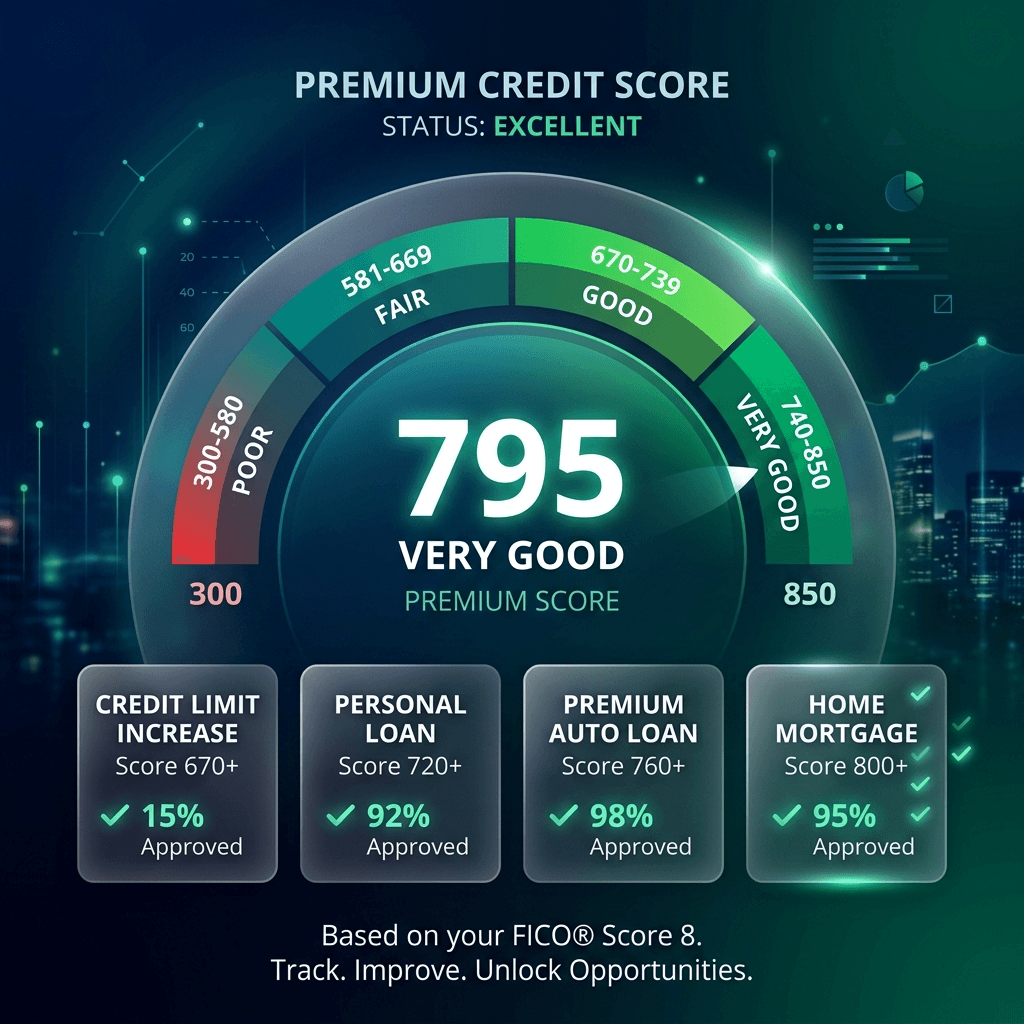
Your credit score determines whether a lender will loan you money - and at what price. Too low, and you face rejection or unaffordable interest rates. High enough, and doors open: better rates, larger limits, faster approvals, and simpler processes.
But "good enough" means different things for different loan types. The score you need for a mortgage differs from what you need for a personal loan, a car loan, or a credit card.
This guide breaks down the minimum, good, and excellent credit score ranges for every major loan category, shows you exactly how much a lower score costs you in interest, and explains how to improve your score quickly before applying.
What Is a Credit Score?
A credit score is a numerical summary of your creditworthiness - a 3-digit number generated by credit bureaus from your borrowing and repayment history.
The standard FICO score range (used in 90% of US lending decisions) is 300 to 850. Lenders use this score to estimate the statistical probability that you will default on a loan payment.
The FICO score is calculated from five categories of information:
According to FICO (2025), the average credit score in the United States stood at 717 - but qualifying for the best interest rates on most loan products requires a score of 740 or higher.
Credit Score Requirements by Loan Type
Here is the credit score landscape for the most common loan products in the US, showing the minimum required for approval, a good score for competitive rates, and the threshold for the best rates.
| Loan Product | Minimum Score for Approval | Good Score for Competitive Rates | Score for Best Rates |
|---|---|---|---|
| FHA Mortgage | 500 (with 10% down) / 580 (with 3.5% down) | 620 | 740+ |
| Conventional Mortgage | 620 | 700 | 740+ |
| Personal Loan | 580 (with some lenders accepting lower) | 670 | 740+ |
| Car Loan (New Vehicle) | 580 (subprime options exist) | 661 | 781+ |
| Car Loan (Used Vehicle) | 580 (subprime options exist) | 661 | 781+ |
| Credit Card (Standard) | 580 | 670 | 720+ |
| Private Student Loan | 650 (often requires a co-signer) | 690 | 740+ |
| Home Equity Loan / HELOC | 620 | 700 | 740+ |
For home buyers, your credit score is the single most important factor determining your interest rate and monthly payment. You can estimate your payments using our Mortgage Calculator. If you are embarking on this journey for the first time, check out our First-Time Home Buyer Checklist to make sure your financial foundation is ready. If you are an existing homeowner looking to lower your interest rate, consult our Mortgage Refinancing Guide to see if refinancing makes financial sense for you.
Credit Score Bands and Loan Access
Exceptional: 800-850
Borrowers in this range present almost no default risk. You will qualify for the absolute lowest interest rates, highest borrowing limits, and fastest approval times across all loan products.
Very Good: 740-799
You are considered a low-risk borrower. You will qualify for near-best interest rates and are highly likely to be approved by virtually any lender.
Good: 670-739
Lenders see you as an average risk. You will be approved for most loans, but you may pay slightly higher interest rates than those in the top tiers.
Fair: 580-669
Borrowers in this range represent above-average risk. You will face more limited lender options, higher interest rates, and lower borrowing limits. Lenders may require co-signers or down payments.
Poor: 300-579
You are considered a high-risk borrower. Most mainstream lenders will reject your application for unsecured products. Your options are generally limited to secured loans (requiring collateral), credit-builder products, or subprime loans with extremely high rates.
Credit Score vs. Interest Rate: The Real Cost of a Fair Score
Let's look at the financial impact of your credit score on a standard $15,000 personal loan repaid over 3 years (36 months).
*The cost of a fair or poor score on a simple $15,000 loan: up to $5,292 in additional interest on the exact same principal amount.*
→ Use our free EMI Calculator to see how different interest rates change your monthly payment and total interest - no sign-up required.
How to Improve Your Credit Score Before You Apply
If your score is currently in the Fair or Poor range, taking 3 to 6 months to improve it before applying for a loan can save you thousands of dollars. Here are the most effective actions you can take.
Action 1: Pay down revolving balances (credit card utilisation)
This is the fastest way to boost your score. Your credit utilisation ratio represents 30% of your score. If you have credit card balances, pay them down to below 30% of your credit limits - below 10% is even better. Dropping your utilisation from 80% to 20% can add 30 to 50 points to your score within a single billing cycle.
Action 2: Dispute credit report errors
Get a free copy of your credit reports from AnnualCreditReport.com. Check for incorrect late payments, credit accounts that don't belong to you, and incorrect balance listings. Disputing these errors and having them removed can result in a significant, sudden score jump.
Action 3: Set up autopay for all bills
Payment history is the single largest category in your score (35%). A single late payment can drop an excellent score by 100 points. Set up automatic minimum payments on all accounts to ensure you never miss a due date.
Action 4: Keep old accounts open
Length of credit history makes up 15% of your score. If you pay off a credit card, keep the account open - especially if it is one of your oldest accounts. Closing it reduces your total available credit limit (increasing your utilisation ratio) and shortens your average account age.
Action 5: Avoid new credit applications
Every time you apply for a loan or credit card, the lender runs a hard credit check, which typically drops your score by a few points. Multiple applications in a short period signal credit-seeking behavior to lenders and suggest financial stress.
The Bottom Line
Your credit score is not a fixed grade on your character - it is a dynamic risk rating that you can actively manage. Knowing what score you need for your target loan is the first step toward borrowing smart.
If your score is below 700, take a few months to pay down revolving debt, check for errors, and build a positive payment history before borrowing. The savings are worth the wait.
Our free EMI Calculator can help you run different loan scenarios and see exactly what interest rates make sense for your budget.
Use our free EMI Calculator to apply what you have learned.
Open EMI Calculator →