
How to Calculate EMI: Formula, Examples & Everything You Need to Know
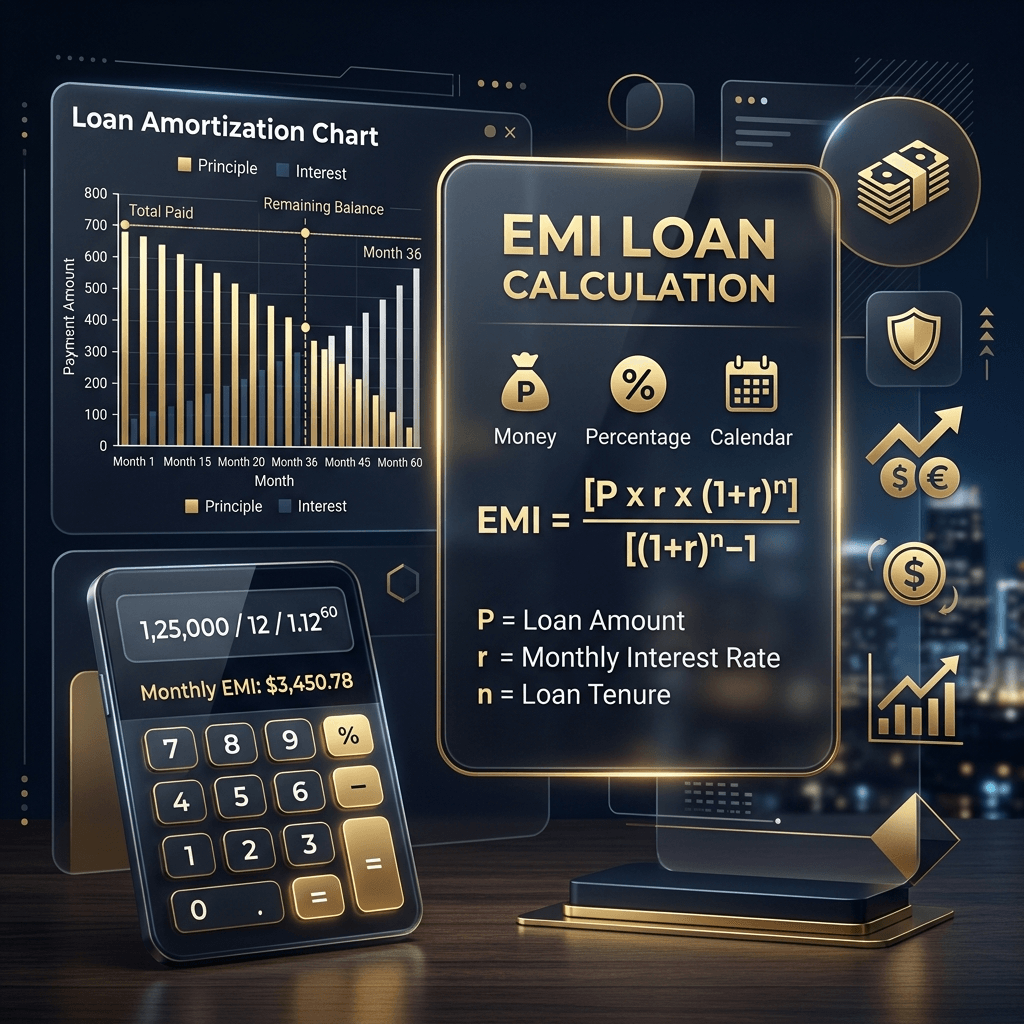
Before you sign a loan agreement, you need to know one number above all others: your EMI. That single monthly figure determines whether the loan fits your budget - or quietly breaks it.
EMI stands for Equated Monthly Instalment. It's the fixed amount you pay every month for the entire duration of a loan, covering both the principal borrowed and the interest charged. Miss it and you damage your credit score. Stretch it too thin and you compromise every other financial goal you have.
This guide explains exactly how EMI is calculated, walks through the formula with real examples, and shows you what happens to your EMI when you change the loan amount, rate, or tenure.
What Is an EMI?
An EMI - Equated Monthly Instalment - is the standardised monthly repayment on a loan. It's called "equated" because the amount stays the same every month throughout the loan tenure, even though the proportion going toward interest versus principal shifts over time.
In the early months of a loan, the majority of your EMI goes toward interest. As the loan matures and the outstanding principal reduces, a progressively larger share of each payment chips away at the principal. This structure is called an amortising loan.
EMIs apply to virtually every type of retail loan: home loans, personal loans, car loans, education loans, and consumer durable loans. Understanding how your EMI is calculated gives you real power - to compare lenders, negotiate terms, and avoid borrowing more than your budget can sustainably handle.
According to the Reserve Bank of India (2025), outstanding retail loan balances across Indian banks exceeded ₹40 lakh crore, with EMI-based personal and housing loans making up the largest share. In the US, the Federal Reserve (2025) reports total household debt at $17.9 trillion - the majority of which is structured as fixed monthly repayments.
How to Calculate EMI - Step by Step
The standard EMI formula used by every bank and lender globally is:
EMI = P × r × (1 + r)ⁿ ÷ [(1 + r)ⁿ − 1]
Where:
Let's work through it step by step.
Step 1: Identify your loan details
You need three inputs: the principal amount, the annual interest rate, and the loan tenure in years (which you'll convert to months).
Example: ₹10,00,000 (₹10 lakh) personal loan at 12% per annum for 3 years.
Step 2: Convert the annual interest rate to monthly
Monthly rate (r) = 12 ÷ 12 ÷ 100 = 0.01
Step 3: Convert tenure to months
n = 3 years × 12 = 36 months
Step 4: Apply the formula
EMI = 10,00,000 × 0.01 × (1.01)³⁶ ÷ [(1.01)³⁶ − 1]
(1.01)³⁶ = 1.4308
EMI = 10,00,000 × 0.01 × 1.4308 ÷ [1.4308 − 1]
EMI = 10,00,000 × 0.014308 ÷ 0.4308
EMI = 14,308 ÷ 0.4308
EMI = ₹33,214 per month
Step 5: Calculate total repayment and interest cost
Total repayment = ₹33,214 × 36 = ₹11,95,704
Total interest paid = ₹11,95,704 − ₹10,00,000 = ₹1,95,704
That's the real cost of the loan - nearly ₹2 lakh in interest on a ₹10 lakh principal over 3 years at 12%.
→ Use our free EMI Calculator to run any loan scenario instantly - no sign-up needed.
Flat rate vs reducing balance: the loan trap
When comparing loan offers, it is critical to understand the method the lender uses to calculate interest. Banks typically calculate interest in one of two ways:
A flat rate appears cheaper on paper but is significantly more expensive in reality. For example, a 10% flat interest rate on a 5-year loan translates to an effective rate under the reducing balance method of nearly double the flat rate. Always ask the lender for the reducing balance interest rate or the Annual Percentage Rate (APR) to compare quotes accurately.
EMI Examples: Home Loan, Car Loan, Personal Loan
Different loan types come with different rates and tenures. Here's how EMI plays out across common loan categories.
Home Loan Example
If you are planning to purchase a home or want to check how different tax rates and escrow charges affect your monthly housing costs, use our dedicated Mortgage Calculator. If you already have a home loan and want to save on interest charges, check our guide on how to pay off your mortgage early to learn strategies that actually work.
Car Loan Example
Personal Loan Example
EMI by the Numbers: How Tenure and Rate Affect Your Payment
Loan amount: $20,000
| Annual Rate | 2-Year Tenure | 3-Year Tenure | 5-Year Tenure | Total Interest (5yr) |
|---|---|---|---|---|
| 7% | $896/mo | $617/mo | $396/mo | $3,760 |
| 10% | $922/mo | $645/mo | $425/mo | $5,496 |
| 13% | $948/mo | $674/mo | $455/mo | $7,300 |
| 16% | $975/mo | $703/mo | $486/mo | $9,160 |
| 20% | $1,015/mo | $743/mo | $530/mo | $11,800 |
Two things stand out clearly from this table. First, a longer tenure reduces your monthly EMI - but dramatically increases total interest paid. Second, even a 3% difference in interest rate costs thousands of dollars over a 5-year loan. Both insights argue for shopping rates aggressively before signing.
Common Mistakes to Avoid
Focusing only on the EMI, not the total cost
A longer tenure lowers your monthly payment - but increases your total interest outgo significantly. Always check the full repayment amount, not just the monthly figure. A $400/month EMI over 7 years costs far more than a $550/month EMI over 5 years.
Ignoring processing fees and hidden charges
Your actual borrowing cost includes processing fees (typically 0.5-2% of the loan amount), prepayment charges, and insurance add-ons. Always calculate the effective annual rate (EAR) or Annual Percentage Rate (APR) - not just the advertised interest rate.
Borrowing at the maximum EMI your income allows
Lenders typically allow EMIs up to 40-50% of net monthly income. Just because you qualify doesn't mean you should. Keep total EMI obligations under 30-35% of take-home pay to preserve breathing room for savings and emergencies.
Not accounting for floating rate risk
Many home loans offer floating rates that start attractively low. If the benchmark rate rises, your EMI rises with it - sometimes substantially. Always stress-test your budget against a rate 1.5-2% higher than the current offer before committing to a floating rate loan.
Skipping the prepayment calculation
If you receive a bonus or windfall, prepaying a portion of your loan principal can dramatically reduce your total interest cost and tenure. Run the prepayment scenario before spending the windfall elsewhere.
Tips to Reduce Your Monthly EMI
If your calculations show that your projected EMI will stretch your monthly budget too thin, consider these actionable steps to lower the payment:
The Bottom Line
Your EMI is the single most important number in any loan decision. Before you borrow, calculate it - and calculate the total repayment, not just the monthly figure. The difference between a 5-year and 7-year tenure can cost you thousands in additional interest.
Our free EMI Calculator gives you the answer in under 30 seconds - run any loan scenario before you commit.
Use our free EMI Calculator to apply what you have learned.
Open EMI Calculator →