
Debt Snowball vs Avalanche: Which Debt Payoff Method Is Right for You?
If you are carrying multiple debts - a credit card balance here, a personal loan there, and a car payment on top - you are probably paying the minimums on most of them and wondering why the balances barely seem to move month after month. The problem isn't your willpower; it's your strategy.
When you have multiple debts, trying to pay a little extra on all of them is an inefficient way to make progress. To get out of debt quickly, you need a targeted plan of attack.
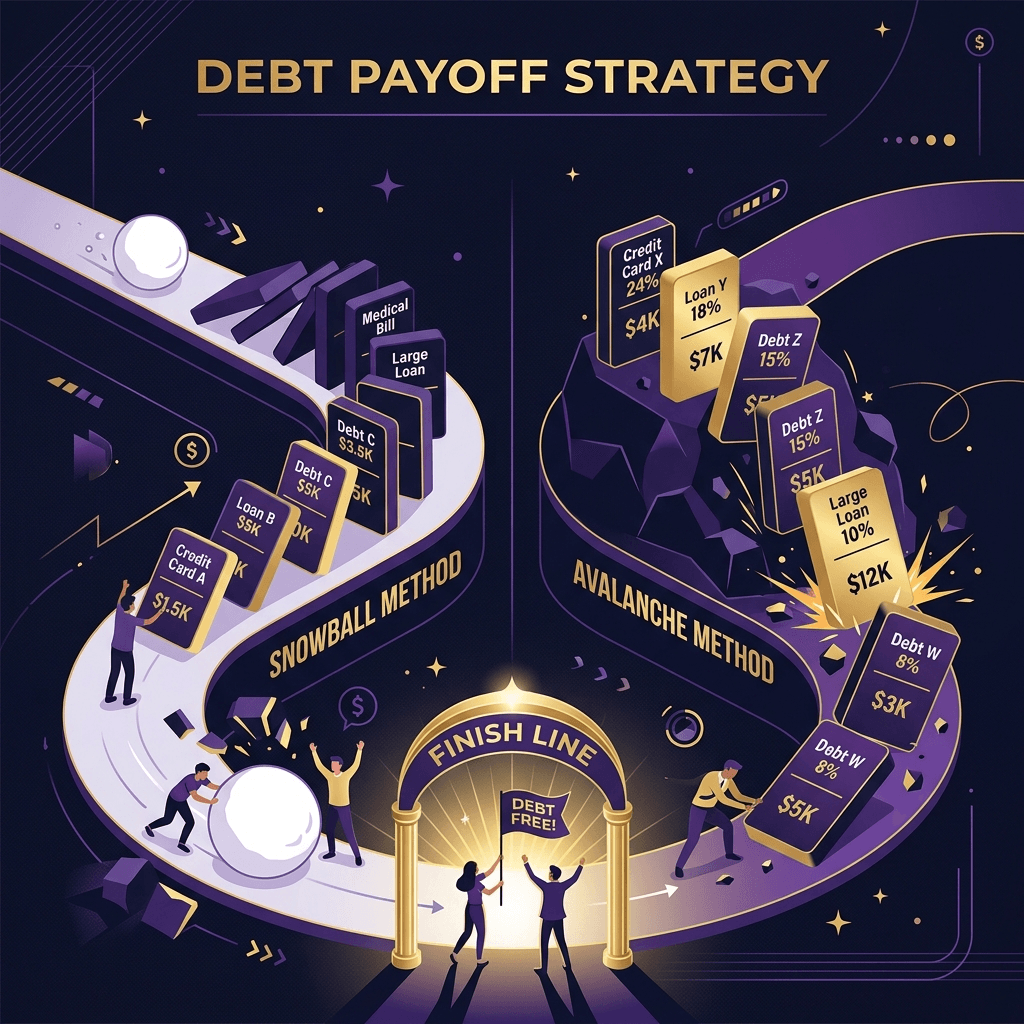
The two most popular and effective debt payoff strategies are the debt snowball and the debt avalanche. Both methods share the same core principle: you pay the minimum amounts on all of your debts except one, which you attack aggressively with every spare dollar you can find. Once that target debt is eliminated, you roll the entire amount you were paying on it onto the next debt - building a progressively larger payment "snowball" or "avalanche" as you go.
The difference between the two is simply which debt you choose to target first. This guide breaks down both methods, walks through a side-by-side example with real numbers, and shows you how to choose the right strategy for your psychological profile and budget.
What is the Debt Snowball Method?
The debt snowball method targets your debts in order of balance size, from smallest to largest - regardless of the interest rate.
Here is how it works:
The primary benefit of the debt snowball is psychological. Popularised by personal finance author Dave Ramsey, this method focuses on behavior modification rather than pure mathematics. Clearing a small debt completely in the first month or two gives you an immediate feeling of accomplishment - a quick win that boosts your motivation and helps you stay committed to the plan.
What is the Debt Avalanche Method?
The debt avalanche method targets your debts in order of interest rate, from highest to lowest - regardless of the balance size.
Here is how it works:
The primary benefit of the debt avalanche is mathematical efficiency. By eliminating your highest-cost debt first, you reduce the total amount of interest that accumulates on your balances during your payoff journey. This saves you the maximum amount of money in interest and often allows you to get out of debt slightly faster.
According to a study published in the Journal of Marketing Research (2016), researchers found that the debt snowball method was actually more effective at helping average consumers eliminate debt because the psychological boost of early wins reduced the likelihood of dropping out of the plan. However, for highly disciplined individuals, the avalanche remains the mathematically optimal choice.
Side-by-Side Example: Snowball vs. Avalanche in Action
Let's look at a realistic example to see exactly how these two strategies play out over time.
Meet James. He has $16,500 in total debt spread across four accounts. His total monthly minimum payments are $410. After looking closely at his monthly budget, he realizes he can free up an additional $500 per month to put toward his debt payoff plan. This gives him a total of $910 per month to work with.
Here is James's debt profile:
| Debt Name | Balance | Interest Rate | Minimum Monthly Payment |
|---|---|---|---|
| Credit Card A | $1,200 | 22% | $35 |
| Medical Bill | $800 | 0% | $25 |
| Personal Loan | $5,500 | 14% | $130 |
| Car Loan | $9,000 | 7.5% | $220 |
Let's see how each method tackles this list.
Scenario A: James uses the Debt Snowball Method
James lists his debts from smallest to largest balance:
*The Payoff Journey:*
Snowball Results:
Scenario B: James uses the Debt Avalanche Method
James lists his debts from highest to lowest interest rate:
*The Payoff Journey:*
Avalanche Results:
Comparison of the two methods
By choosing the debt avalanche, James saved $630 in interest and became debt-free one month earlier than he would have with the debt snowball.
However, notice the psychological difference. With the debt snowball, James cleared two entire debts in the first 4 months. With the debt avalanche, he had to wait until month 10 to clear his second debt. For many people, that longer wait can make the plan feel like it isn't working - increasing the risk that they give up and return to their old spending habits.
Debt Snowball vs. Debt Avalanche: At a Glance
| Factor | Debt Snowball | Debt Avalanche |
|---|---|---|
| **Target Order** | Smallest balance first | Highest interest rate first |
| **Mathematically Optimal** | No | Yes |
| **Psychologically Motivating** | High (quick wins early) | Low (can feel slow early) |
| **Interest Savings** | Lower | Higher |
| **Risk of Dropout** | Lower | Higher |
| **Best For** | Borrowers who need quick wins to stay motivated | Highly disciplined borrowers focused on minimising interest |
Common Mistakes to Avoid
Not keeping a small cash buffer
When you throw every spare dollar at your debt, you leave yourself vulnerable to unexpected expenses (car repairs, medical emergencies). Without a small emergency fund (typically $1,000 or one month's expenses), a minor emergency will force you to borrow more money - breaking your momentum.
Neglecting to pay the minimums on other debts
Both methods require you to pay the minimum payment on *all* debts except the target debt. Missing a minimum payment on a non-target debt will trigger late fees and damage your credit score, erasing the benefits of your payoff progress.
Ignoring the interest rates entirely on the snowball
While the snowball method tells you to ignore interest rates for targeting, you should still look for opportunities to reduce the rates on your larger debts. Refinancing a high-rate personal loan or car loan to a lower rate can save you significant money while you work your way up the snowball.
Increasing your lifestyle as debts are cleared
As you clear individual debts, you will feel a sense of financial relief. The temptation is to use that newly freed cash flow to upgrade your lifestyle. Resist this temptation. You must roll the *entire* payment of the cleared debt into the next one for the strategy to work.
Not building a plan for *after* the debt is gone
Once the final payment is made, you will have a significant amount of surplus cash flow. Without a clear plan to direct that money toward savings, investing, or home ownership, it is very easy to let it slip back into lifestyle inflation.
How to Choose the Right Strategy for You
The best debt payoff method is the one you will actually stick to.
Choose the Debt Snowball if:
Choose the Debt Avalanche if:
Regardless of which method you choose, the key is to start immediately. Run your numbers, select your target debt, and throw everything you can at it.
Our free EMI Calculator can help you model your loan repayment schedules and see how prepayments can shorten your payoff timeline.
Use our free EMI Calculator to apply what you have learned.
Open EMI Calculator →