
How to Calculate ROI: Formula, Examples & What It Really Tells You
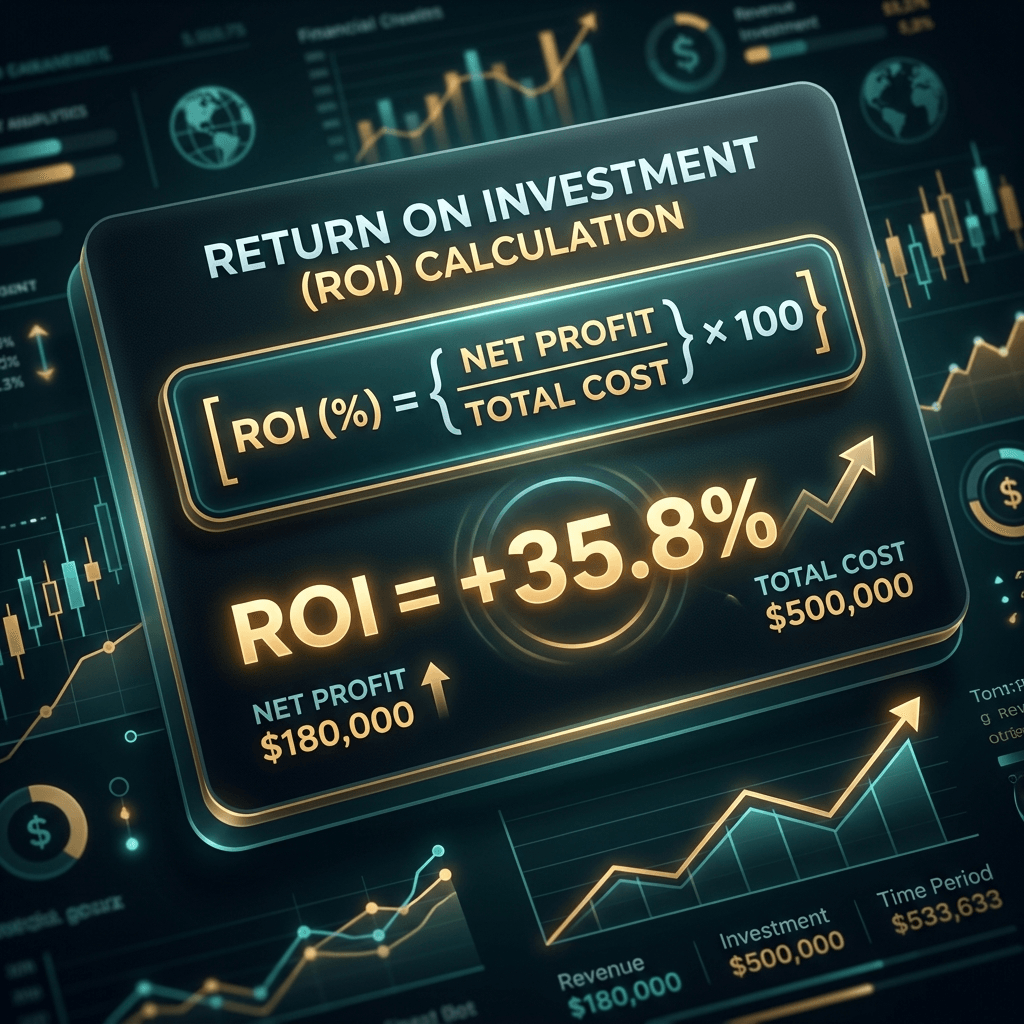
ROI - Return on Investment - is one of the most used and most misused metrics in finance. Used correctly, it gives you a clean, comparable percentage that tells you how efficiently money was deployed. Used carelessly, it gives you a number that looks precise but masks important context.
This guide covers exactly how to calculate ROI, walks through examples across investment types, explains the limitations you need to know, and shows you when a high ROI number might still indicate a bad decision.
What Is ROI?
Return on Investment (ROI) is a performance metric that measures the gain or loss from an investment relative to its cost. It's expressed as a percentage, making it easy to compare investments of different sizes.
At its core, ROI answers one question: for every dollar I put in, how much did I get back above what I spent?
An ROI of 20% means you made $20 for every $100 invested. An ROI of -15% means you lost $15 per $100. An ROI of 0% means you broke even.
ROI is used across contexts - stock investments, real estate, business decisions, marketing campaigns, education - because its simplicity makes it universally applicable. That same simplicity is also its biggest limitation, which we'll cover in detail.
How to Calculate ROI - Step by Step
The standard ROI formula is:
Where:
* Net Profit = Final Value of Investment − Cost of Investment
* Cost of Investment = The total amount you put in (purchase price plus any additional costs)
This can also be written as:
Both formulas produce the same result. Let's work through each step.
Step 1: Identify your initial investment cost
Include everything you paid to make the investment - not just the purchase price. For stocks, this includes brokerage commissions. For real estate, it includes closing costs, legal fees, and renovation expenses. For a business investment, it includes all capital deployed.
Step 2: Determine the final value
This is what the investment is currently worth, or what you received when you exited. For a sold investment, it's the sale price. For an ongoing investment, it's the current market value.
Step 3: Calculate net profit
If the result is positive, you made money. Negative means a loss.
Step 4: Divide by the initial cost
Step 5: Multiply by 100 to express as a percentage
To calculate percentage growth or convert fractions to percentages easily without manual formulas, run the figures through our free percentage calculator.
→ Use our free Investment Calculator to calculate ROI on any investment instantly - no sign-up needed.
ROI Examples Across Different Investment Types
Example 1: Stock Investment
* Bought 50 shares at $40 each = $2,000 invested
* Sold at $54 per share = $2,700 received
* Brokerage fee: $10
* Net Profit: $2,700 − $2,000 − $10 = $690
* ROI: ($690 ÷ $2,010) × 100 = 34.3%
Example 2: Real Estate
* Purchase price: $280,000
* Renovation and closing costs: $20,000
* Total investment: $300,000
* Sale price after 3 years: $370,000
* Net Profit: $370,000 − $300,000 = $70,000
* ROI: ($70,000 ÷ $300,000) × 100 = 23.3%
* *Note: This ROI doesn't account for rental income received during ownership, mortgage interest paid, or property taxes - all of which affect the true return. Full real estate ROI calculations require accounting for all cash flows.*
Example 3: Business Marketing Campaign
* Campaign cost: $5,000
* Revenue generated attributable to campaign: $18,000
* Net Profit: $18,000 − $5,000 = $13,000
* ROI: ($13,000 ÷ $5,000) × 100 = 260%
Example 4: Education / Upskilling
* Cost of professional certification: $1,200
* Annual salary increase after certification: $6,000
* First-year ROI: ($6,000 − $1,200) ÷ $1,200 × 100 = 400%
ROI by the Numbers: Benchmarks to Know
| Investment Type | Typical Annual ROI Range | Notes |
|---|---|---|
| US stock market (S&P 500) | 8-10% (long-run average) | Before inflation; historical average since 1957 |
| Real estate (US, appreciation only) | 3-5% annually | Does not include rental yield |
| Real estate (including rental yield) | 7-12% | Highly location-dependent |
| Corporate bonds | 3-6% | Lower risk than equities |
| Government bonds (US Treasuries, 2026) | 4-4.5% | Near risk-free rate |
| High-yield savings | 4-5% | Capital-guaranteed, FDIC insured |
| Business investments | Highly variable | Typically 15-30%+ required to justify risk |
*Long-run S&P 500 data sourced from Robert Shiller's CAPE dataset (Yale, updated 2025). All figures are illustrative averages.*
The Critical Limitation: ROI Ignores Time
The most important flaw in the basic ROI formula is that it doesn't account for how long the money was invested.
Consider two investments:
* Investment A: 30% ROI in 1 year
* Investment B: 30% ROI in 5 years
The basic ROI formula gives them the same score. But Investment A is dramatically superior - it returned 30% annually, while Investment B returned roughly 5.4% per year (annualised).
To compare investments fairly across different timeframes, use Annualised ROI (also called CAGR - Compound Annual Growth Rate):
Where $n$ = number of years.
For Investment B above: $[(1.30)^{1/5} - 1] imes 100 = extbf{5.4% per year}$
Always annualise ROI when comparing investments held for different periods.
Common Mistakes to Avoid
* Not including all costs: A stock investment that ignores brokerage fees, a real estate investment that ignores closing costs and maintenance, or a business investment that ignores staff time - all produce an artificially inflated ROI. Always include the full cost of capital deployed.
* Comparing non-annualised ROIs across different time periods: A 50% ROI over 10 years sounds impressive until you annualise it to 4.1% per year - which barely beats a high-yield savings account. Always convert to annualised figures before comparing investments with different holding periods.
* Ignoring risk: Two investments with identical ROI are not equivalent if one is guaranteed and the other is highly volatile. A 7% return from a government bond involves virtually no principal risk; a 7% return from a single small-cap stock carries enormous risk. ROI tells you the return but says nothing about the risk taken to achieve it.
* Confusing gross revenue with profit: In business contexts especially, people sometimes calculate ROI using revenue rather than profit - producing wildly inflated figures. ROI must be calculated on net gain (revenue minus all associated costs), not on top-line revenue.
* Using ROI in isolation for major decisions: ROI is one input, not a complete decision framework. A real estate investment with a 15% ROI that required full-time management involvement and significant stress is not comparable to a 12% passive index fund return. Qualitative factors - liquidity, time commitment, risk, opportunity cost - all matter alongside the number.
The Bottom Line
ROI is one of the most useful tools in financial decision-making - and one of the easiest to misuse. Calculate it correctly (include all costs), annualise it when comparing across timeframes, and always pair it with a measure of risk before making a decision. A number without context is just a number.
*Investment Calculator gives you the answer in under 30 seconds - try it free at globalutilityhub.com/finance-tools/investment-calculator/ to calculate and compare ROI across any investment scenario.*
Use our free Investment Calculator to apply what you have learned.
Open Investment Calculator →