
Index Funds vs ETFs: What's the Difference and Which Should You Choose?
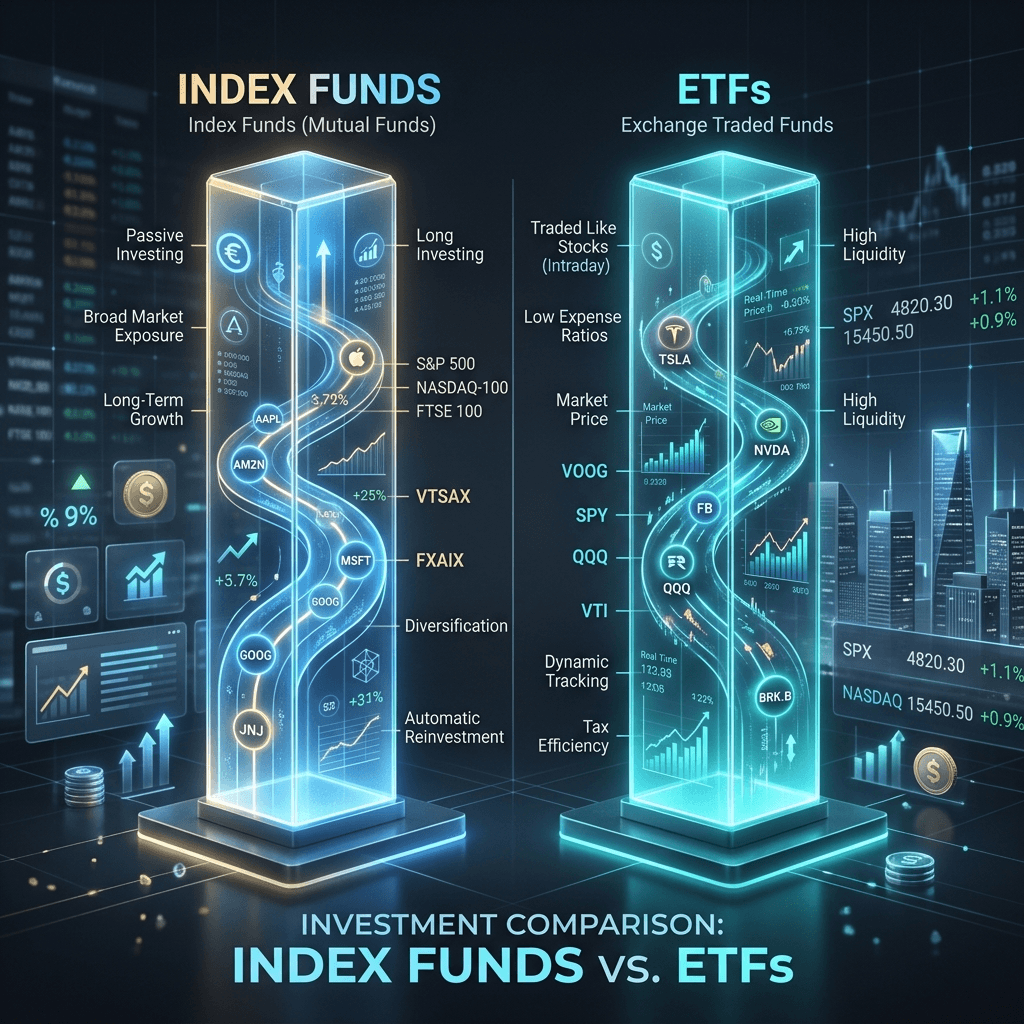
If you've researched how to start investing, you've almost certainly encountered both index funds and ETFs - often in the same sentence, often treated as interchangeable. They're not. They share a lot of DNA, but they work differently, cost differently, and suit different investor styles.
Understanding the distinction matters more than most beginner guides suggest - not because one is dramatically better than the other, but because choosing the wrong one for how you invest can create unnecessary friction, costs, or tax consequences.
This guide explains exactly what each product is, how they differ, and which makes more sense for your specific situation.
What Is an Index Fund?
An index fund is a type of mutual fund designed to replicate the performance of a specific market index - such as the S&P 500, the FTSE 100, or the MSCI World Index. Instead of a fund manager actively selecting investments, the fund simply buys all (or a representative sample) of the securities in its target index, in the same proportions.
The goal is not to beat the market - it's to match it. This passive approach dramatically reduces management costs and eliminates the guesswork of stock picking.
Index funds are purchased directly from the fund provider (Vanguard, Fidelity, BlackRock) or through a brokerage. You submit a purchase order during the trading day, but the transaction executes at the fund's Net Asset Value (NAV) - a single price calculated at market close.
What Is an ETF?
An Exchange-Traded Fund (ETF) is also a fund that tracks an index - but it trades on a stock exchange throughout the day, just like an individual stock. You can buy or sell an ETF at any point during market hours at the current market price, which fluctuates in real time.
Most ETFs are index-tracking by design (passive), but actively managed ETFs also exist. For the purposes of this comparison, we're focusing on the passive, index-tracking ETFs that the vast majority of beginner and long-term investors use.
The key structural difference from index funds: ETFs trade intraday on an exchange; traditional index funds transact once per day at NAV.
*According to Investment Company Institute data (2025), global ETF assets under management exceeded $14 trillion, with index-tracking ETFs accounting for the vast majority of flows.*
Index Funds vs ETFs: The Key Differences
Step 1: How you buy and sell them
* Index funds: You place an order with the fund provider or your brokerage. The order executes at the end of the trading day at NAV. You can't buy or sell during market hours at a live price.
* ETFs: You buy and sell on a stock exchange through a brokerage, exactly like a stock. The price fluctuates throughout the day based on supply and demand. You can place limit orders, stop orders, and buy at any point during market hours.
* *For long-term investors making regular contributions and holding for years, this difference is largely irrelevant - the price difference between intraday trades and end-of-day NAV is typically tiny.*
Step 2: Minimum investment
* Index funds: Traditionally required minimum investments - $1,000, $2,500, or $3,000 with some providers. Vanguard's Admiral Shares, for example, historically required $3,000. Many providers have now lowered minimums significantly, with Fidelity and Schwab offering several index funds with $0 minimums.
* ETFs: You can buy a single share, meaning your minimum investment equals one share price - which ranges from a few dollars to a few hundred. Brokerages offering fractional shares reduce this even further.
* *For beginners with smaller amounts to invest, ETFs have historically offered a lower entry point - though this gap has largely closed as index fund minimums have dropped.*
Step 3: Costs and expense ratios
Both index funds and ETFs are extremely cost-competitive compared to actively managed funds. Expense ratios on popular options:
* Vanguard S&P 500 Index Fund (VFIAX): 0.04% annually
* Vanguard S&P 500 ETF (VOO): 0.03% annually
* Fidelity ZERO Total Market Index Fund: 0.00%
* iShares Core S&P 500 ETF (IVV): 0.03%
* SPDR S&P 500 ETF (SPY): 0.0945%
The difference between 0.03% and 0.04% on $10,000 is $1 per year - entirely negligible. However, ETFs were traditionally purchased with brokerage commissions per trade. With commission-free trading now standard at major brokerages, this advantage has largely disappeared.
→ Use our free Investment Calculator to model how even small differences in expense ratios compound over long time horizons - no sign-up needed.
Step 4: Tax efficiency
This is where ETFs hold a structural advantage, particularly in the United States.
ETFs use a creation/redemption mechanism through institutional investors called authorised participants. This allows ETFs to satisfy investor redemptions without selling underlying securities - meaning they rarely generate taxable capital gains distributions.
Index funds, by contrast, must sometimes sell securities to meet redemptions, which can trigger capital gains distributions passed through to all remaining fund holders - even if you didn't sell your shares.
In tax-advantaged accounts (401k, IRA, ISA), this distinction is irrelevant - gains aren't taxable regardless. In taxable brokerage accounts, the ETF's structural tax efficiency is a meaningful advantage.
Step 5: Dividend reinvestment
* Index funds: Most offer automatic dividend reinvestment at no cost. Dividends are automatically used to buy more fund units.
* ETFs: Dividend reinvestment (DRIP) is available at most brokerages but varies by platform. Some reinvest automatically; others pay dividends as cash that you must manually reinvest. Manual reinvestment may be impractical for small dividend amounts.
Side-by-Side Comparison
| Feature | Index Fund | ETF |
|---|---|---|
| **Trading** | Once daily at NAV | Throughout day like a stock |
| **Minimum investment** | Varies ($0-$3,000+) | Cost of 1 share (or fractional) |
| **Expense ratio** | Very low (0.00-0.20%) | Very low (0.03-0.20%) |
| **Commission** | None (most brokerages) | None (most brokerages) |
| **Tax efficiency (taxable accounts)** | Good | Slightly better |
| **Automatic dividend reinvestment** | Yes | Varies by platform |
| **Bid-ask spread** | None | Small spread applies |
| **Suitable for lump sum** | Yes | Yes |
| **Suitable for regular small contributions** | Yes | Yes (if fractional shares available) |
| **Complexity** | Very simple | Simple |
Common Mistakes to Avoid
* Choosing based on intraday trading ability when you don't need it: The ability to trade an ETF throughout the day is a feature that long-term investors should actively ignore. The investors most tempted by real-time ETF pricing are the ones most likely to make emotionally driven buy and sell decisions. If your plan is buy, hold, and contribute for 20 years, intraday trading is irrelevant - and potentially dangerous.
* Ignoring the bid-ask spread on ETFs: ETFs trade on exchanges, which means there's a bid price (what buyers will pay) and an ask price (what sellers want). The difference - the spread - is a hidden cost that index funds don't have. For major ETFs like VOO or IVV, the spread is typically 1 cent on a $500 share - negligible. For smaller, less liquid ETFs, spreads can be wider and worth factoring in.
* Assuming all ETFs are passive index trackers: The ETF wrapper can contain any investment strategy - actively managed funds, leveraged funds, inverse funds, thematic funds with high turnover and fees. Never assume an ETF is a low-cost index tracker without checking its investment strategy and expense ratio. The structure (ETF) and the strategy (index tracking vs active) are separate things.
* Over-complicating with too many funds: A common beginner mistake is buying five or six different ETFs and index funds covering overlapping markets - creating a complicated, expensive portfolio that essentially replicates what a single total market fund would do for less effort and cost. One or two broad market funds is almost always sufficient for a long-term beginner portfolio.
The Bottom Line
For most beginner and long-term investors, the choice between an index fund and an ETF is a minor operational decision, not a major strategic one. Both give you low-cost, diversified exposure to the same markets. Both have outperformed the majority of actively managed funds over 10+ year periods.
If you're in a taxable account and want marginal tax efficiency: lean toward ETFs. If you want the simplicity of automatic dividend reinvestment and no concern about bid-ask spreads: lean toward index funds. If you're in a tax-advantaged account: choose whichever has the lower expense ratio and the most convenient access on your platform.
*Investment Calculator gives you the answer in under 30 seconds - try it free at globalutilityhub.com/finance-tools/investment-calculator/ to model long-term returns on index funds and ETFs at different contribution rates.*
Use our free Investment Calculator to apply what you have learned.
Open Investment Calculator →