
Dollar Cost Averaging Explained: How It Works and Why It Beats Timing the Market
Most people don't invest because they're waiting for the right moment. They're watching the market, waiting for a dip, planning to buy when things look clearer. Weeks turn into months. The perfect moment never comes. And the money sits in a savings account losing ground to inflation.
Dollar cost averaging (DCA) is the antidote to this paralysis. It's a strategy so simple it can be set up in 10 minutes - and so effective that most professional financial advisors recommend it to the majority of individual investors over any other approach.
This guide explains exactly how dollar cost averaging works, why it outperforms market timing for most investors, and how to implement it today.
What Is Dollar Cost Averaging?
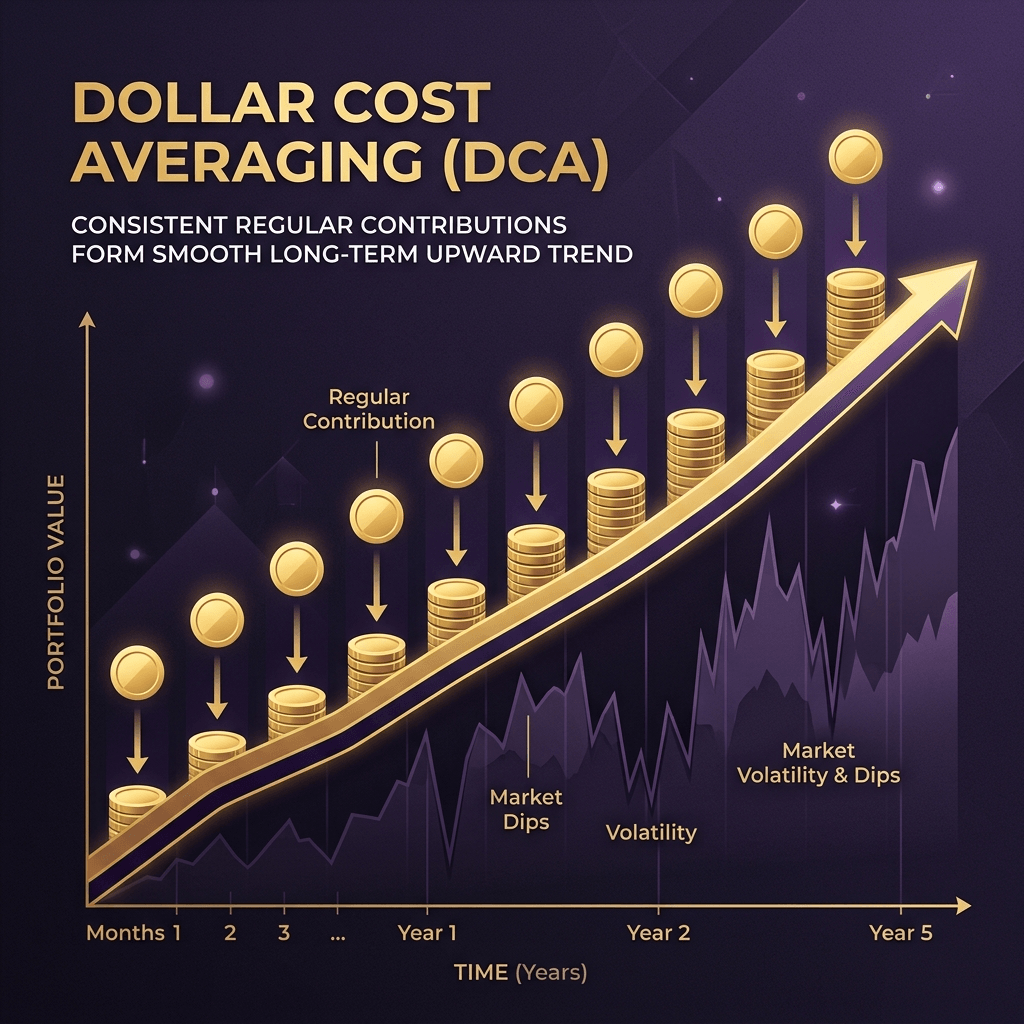
Dollar cost averaging is an investment strategy where you invest a fixed amount of money at regular intervals - weekly, fortnightly, or monthly - regardless of what the market is doing at the time.
Instead of trying to invest a lump sum at the "right" price, you invest consistently over time. When prices are high, your fixed amount buys fewer units. When prices are low, the same amount buys more. Over time, this averages out your cost per unit - typically below the average market price during the period.
The term "dollar cost averaging" originated in the US, though the strategy is used globally and referred to as regular investment, systematic investment, or pound cost averaging in the UK.
It's the mechanism behind most workplace pension and retirement plans: a fixed percentage of your salary is invested every payday, automatically, without any decision required on your part.
*According to Vanguard research (2024), lump sum investing outperforms dollar cost averaging approximately two-thirds of the time when invested in a rising market - because markets go up more often than they go down. However, DCA consistently outperforms for investors who would otherwise delay investing entirely, and for those who receive income periodically rather than as a one-time windfall.*
How Dollar Cost Averaging Works - Step by Step
The mechanics are straightforward. What makes DCA powerful is its consistency and its removal of emotional decision-making from the investment process.
Step 1: Choose your investment vehicle
DCA works best with broadly diversified, low-cost funds - a total market index fund or ETF. Applying DCA to individual stocks or high-volatility assets introduces stock-specific risk that diversification would otherwise eliminate.
Step 2: Decide on your fixed investment amount
Choose an amount you can commit to investing every period without exception - including during market downturns, negative news cycles, and months when your budget feels tight. This amount should come from your regular income surplus, not from emergency savings.
Common starting points: $50, $100, $200, or $500 per month. The amount matters less than the consistency.
Step 3: Choose your investment frequency
Monthly is the most common - it aligns with salary payment cycles and simplifies tracking. Fortnightly or weekly contributions work equally well mathematically, and some investors prefer smaller, more frequent amounts.
Step 4: Automate the transfer
Set up an automatic investment instruction with your brokerage on the day your salary clears. This removes the decision entirely - the investment happens whether markets are up, down, or in freefall. Automation is what converts DCA from a strategy into a habit.
Dollar Cost Averaging in Action: A Real Example
Sarah invests $300 every month into a broad market index fund over 6 months. Here's how DCA plays out:
| Month | Amount Invested | Price Per Unit | Units Purchased | Total Units Held |
|---|---|---|---|---|
| January | $300 | $50.00 | 6.00 | 6.00 |
| February | $300 | $45.00 | 6.67 | 12.67 |
| March | $300 | $40.00 | 7.50 | 20.17 |
| April | $300 | $42.00 | 7.14 | 27.31 |
| May | $300 | $48.00 | 6.25 | 33.56 |
| June | $300 | $52.00 | 5.77 | 39.33 |
| **Total** | **$1,800** | **39.33 units** |
* Average price paid per unit: $1,800 ÷ 39.33 = $45.77
* Average market price over the 6 months: ($50 + $45 + $40 + $42 + $48 + $52) ÷ 6 = $46.17
Sarah paid $45.77 per unit on average - less than the average market price of $46.17, despite prices fluctuating up and down. This is DCA's core mathematical advantage: buying more units automatically when prices are low pulls the average cost below the simple average price.
* Portfolio value at end of June: 39.33 units × $52 = $2,045
* Total invested: $1,800. Return: +$245 (+13.6%) in 6 months - while the price only returned to $2 above the starting point.
DCA vs Lump Sum: When Each Makes Sense
| Scenario | Recommended Approach | Reason |
|---|---|---|
| **Regular monthly income** | DCA | Natural fit; invest each payday |
| **One-time windfall (bonus, inheritance)** | Lump sum | Markets rise more than they fall; time in market matters |
| **Windfall but high anxiety about market timing** | DCA over 6-12 months | Psychological benefit outweighs slight mathematical cost |
| **Market at all-time high (concerned about entry)** | DCA | Reduces risk of investing peak before correction |
| **Bear market (prices already down significantly)** | Lump sum or aggressive DCA | More units at lower prices |
| **Beginner with no existing investments** | DCA | Builds habit and reduces emotional risk |
Long-Term DCA Growth: The Compounding Effect
Monthly DCA of $200 into a broad market index fund (8% average annual return):
| Years | Total Invested | Portfolio Value | Total Gain |
|---|---|---|---|
| **5 years** | $12,000 | $14,693 | +$2,693 |
| **10 years** | $24,000 | $36,589 | +$12,589 |
| **15 years** | $36,000 | $69,082 | +$33,082 |
| **20 years** | $48,000 | $117,804 | +$69,804 |
| **30 years** | $72,000 | $298,072 | +$226,072 |
*Figures are illustrative, assuming consistent 8% annual return. Actual returns vary and are not guaranteed.*
The compounding effect accelerates dramatically in later years. The investor contributes $72,000 over 30 years and ends with nearly $300,000 - a gain of over $226,000 from simply investing $200 consistently each month without ever timing the market.
Common Mistakes to Avoid
* Pausing contributions during market downturns: This is the single most costly mistake DCA investors make. A market drop is the best possible time for a DCA investor - your fixed amount buys more units at lower prices, reducing your average cost and amplifying future gains when prices recover. Pausing during downturns turns DCA from a strategy into a version of market timing.
* Applying DCA to individual stocks: DCA works because a diversified index fund will recover from downturns. An individual company can go bankrupt and never recover. Consistently buying more shares of a failing company at lower prices doesn't average your cost down - it averages your loss deeper.
* Investing inconsistent amounts: Investing $500 in a good month and $50 in a bad month defeats the strategy. Consistency in amount is what produces the mathematical averaging effect. Set an amount you can sustain in your worst months and commit to it.
* Stopping when the goal feels distant: The first few years of DCA can feel slow - small balances growing modestly. The compounding acceleration happens later. Investors who stop contributing after 3-4 years because "it's not working" miss the phase where the real wealth builds.
* Choosing a high-fee fund for DCA: The impact of expense ratios compounds just as returns do. A 1% annual fee on a $200/month DCA over 30 years at 8% reduces your final balance by approximately $80,000 compared to a 0.05% fee fund. Fees matter enormously over long investment horizons.
The Bottom Line
Dollar cost averaging isn't glamorous. There's no market reading required, no perfect entry point to calculate, no charts to analyse. You decide an amount, automate the transfer, and let time and compounding do the work.
That simplicity is the point. The biggest threat to long-term investment returns isn't market volatility - it's the investor's own impulse to time, pause, or second-guess. DCA removes all three from the equation.
*Investment Calculator gives you the answer in under 30 seconds - try it free at globalutilityhub.com/finance-tools/investment-calculator/ to model your DCA contributions over any time horizon.*
Use our free Investment Calculator to apply what you have learned.
Open Investment Calculator →