
How Inflation Erodes Your Savings: And What to Do About It
What Is Inflation?
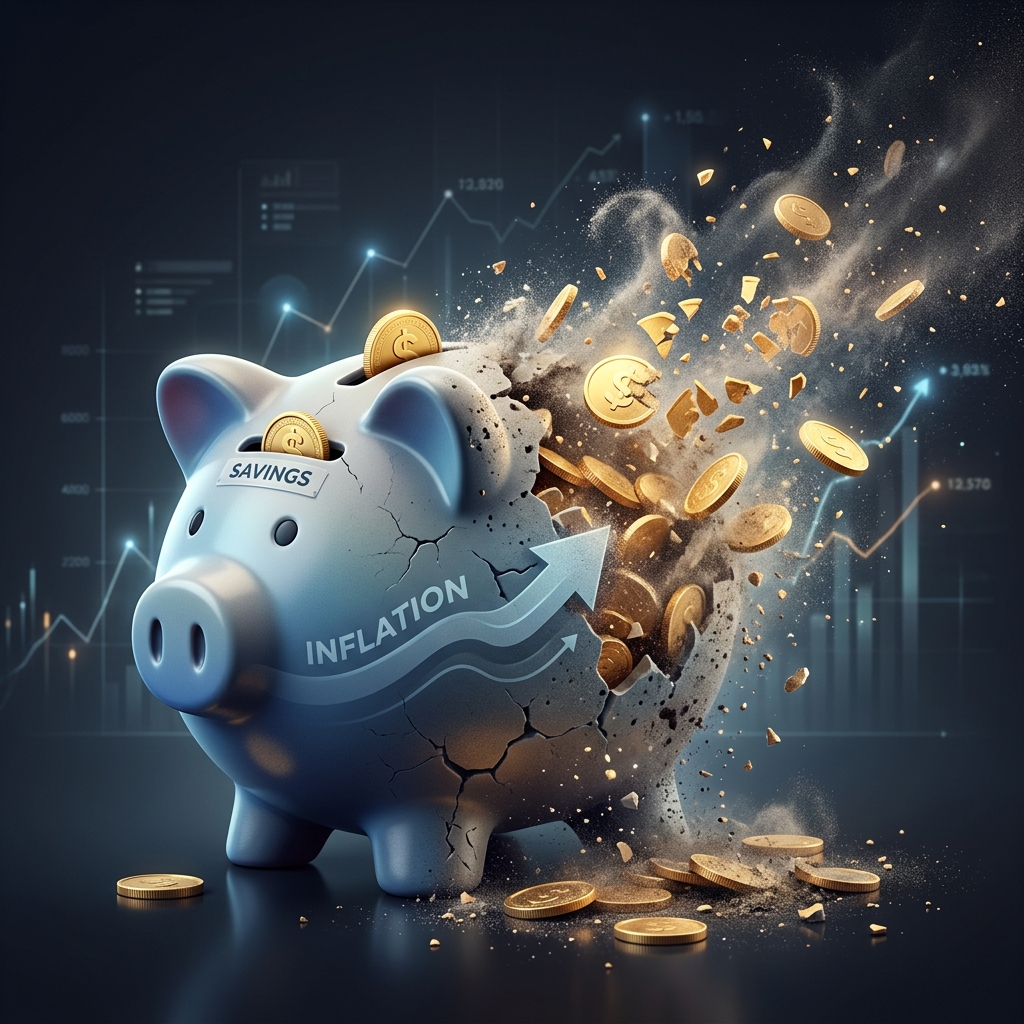
Inflation is the rate at which the general price level of goods and services rises over time. When inflation is 3%, a basket of goods that cost $1,000 this year costs $1,030 next year. The dollar hasn't changed, but it buys less.
From a savings perspective, inflation is not a problem you can ignore by leaving money in the bank. It's a problem that compounds against you whether you engage with it or not.
In the United States, inflation is measured primarily through two indices:
* CPI (Consumer Price Index): Tracks the average price change of a basket of consumer goods and services. Published monthly by the Bureau of Labor Statistics.
* PCE (Personal Consumption Expenditures): The Federal Reserve's preferred inflation measure, generally running slightly below CPI.
The Federal Reserve targets 2% annual inflation as its long-run objective. In practice, inflation has ranged from near zero (2015) to a peak of 9.1% (June 2022) in recent years. As of early 2026, US CPI inflation has returned to approximately 2.5-3% annually, above target but substantially lower than the 2022-2023 peaks.
How Inflation Erodes Your Savings: The Maths
The impact of inflation on savings is captured by the real rate of return:
Real Rate of Return = Nominal Interest Rate - Inflation Rate
If your savings account earns 4.5% APY and inflation is 3%, your real rate of return is 1.5%: you're growing your purchasing power, but only modestly.
If your savings account earns 0.5% APY and inflation is 3%, your real rate of return is -2.5%: you're losing 2.5% of purchasing power every year even as your balance nominally grows.
The Rule of 72 applied to inflation: Divide 72 by the inflation rate to find how many years it takes for inflation to cut your purchasing power in half.
* At 2% inflation: 72 ÷ 2 = 36 years to halve purchasing power
* At 3% inflation: 72 ÷ 3 = 24 years to halve purchasing power
* At 6% inflation: 72 ÷ 6 = 12 years to halve purchasing power
Step-by-Step: Calculating Inflation's Real Impact on Your Savings
Step 1: Identify your current savings balance and interest rate
Example: $50,000 in a savings account earning 2.0% APY.
Step 2: Identify the current inflation rate
Using 3% (approximate 2026 CPI rate).
Step 3: Calculate your real rate of return
Real return = 2.0% - 3.0% = -1.0%
Your savings are losing 1.0% of purchasing power per year.
Step 4: Project forward using the real return
After 10 years at −1.0% real return: $50,000 × (1 - 0.01)^{10} = 50,000 × 0.904 = 45,200$ in today's purchasing power
Despite the account growing nominally to approximately $60,950 (at 2% nominal), the real value (what that money can actually buy) is only $45,200 in today's terms. You've lost $4,800 in real purchasing power over 10 years simply by leaving money in a low-rate account.
Step 5: Compare against a higher-return scenario
At 4.5% APY savings rate against 3% inflation (real return +1.5%): After 10 years: $50,000 × (1.015)^{10} = 50,000 × 1.161 = 58,050$ in today's purchasing power
The difference between a 2.0% and 4.5% savings account over 10 years, in real purchasing power on $50,000, is approximately $12,850.
→ Use our free Net Worth Calculator at GlobalUtilityHub to track how your savings and investments are growing in real terms - no sign-up needed.
Inflation's Impact Across Different Asset Classes
| Asset Class | Typical Nominal Return (2026) | vs 3% Inflation | Real Return | Assessment |
|---|---|---|---|---|
| Under-mattress cash | 0% | -3% | -3.0% | Guaranteed loss |
| Big-bank savings account | 0.5% | -2.5% | -2.5% | Poor |
| National average savings | 0.46% | -2.54% | -2.54% | Poor |
| High-yield savings account | 4.5% | +1.5% | +1.5% | Beats inflation modestly |
| US Treasury bonds (10yr) | 4.3% | +1.3% | +1.3% | Beats inflation modestly |
| Investment-grade bonds | 5.0% | +2.0% | +2.0% | Modest real return |
| S&P 500 index (long-run avg) | 10% nominal / ~7% real | +7.0% | +7.0% | Strong real growth |
| Real estate (appreciation + yield) | 8-12% | +5-9% | +5-9% | Strong, location-dependent |
| TIPS (inflation-linked bonds) | CPI + 1.5-2% | +1.5-2% | Guaranteed real return | Protection, not growth |
Nominal returns are approximate long-run averages or current yields as of 2026. Past returns do not guarantee future results.
The Inflation Trap: Three Common Scenarios
Scenario 1: The "Safe" Saver
Sarah keeps $80,000 in a standard savings account earning 0.5%. Inflation runs at 3%. After 20 years, her balance has grown nominally to $88,400. But in real purchasing power, it's worth approximately $57,600 in today's dollars, a real-terms loss of $22,400 despite never withdrawing a penny.
Scenario 2: The High-Yield Saver
James keeps his $80,000 in a high-yield savings account earning 4.5%. Same 3% inflation. After 20 years, his balance is approximately $193,000 nominally, and approximately $119,000 in today's purchasing power. A real-terms gain of $39,000.
Scenario 3: The Investor
Priya invests her $80,000 in a broad stock index fund averaging 10% nominal (7% real) annually. After 20 years, her balance is approximately $539,000 nominally, and approximately $294,000 in today's purchasing power. A real-terms gain of $214,000.
The difference between Scenario 1 and Scenario 3 over 20 years: $236,400 in real purchasing power, from the same starting amount, with no additional contributions.
Strategies to Protect Your Savings From Inflation
Strategy 1: Move idle savings to a high-yield savings account The simplest, lowest-risk step. Switching from a 0.5% big-bank account to a 4.5% HYSA requires no risk and takes 15 minutes. On $50,000, that's a difference of $2,000 in annual interest, every year.
Strategy 2: Invest long-term savings in the stock market Cash held for 5+ years should not sit in savings accounts. A diversified equity portfolio has historically outpaced inflation by 6-7% annually over the long run. The short-term volatility is the price paid for long-term real growth.
Strategy 3: Use TIPS (Treasury Inflation-Protected Securities) TIPS are US government bonds whose principal adjusts with CPI inflation. They guarantee a real return above inflation, making them ideal for the portion of a portfolio where capital preservation in real terms is the priority. Appropriate for conservative investors or those approaching retirement.
Strategy 4: Hold real assets (real estate and commodities) Property values and commodity prices tend to rise with inflation, making them natural hedges. Real estate provides both capital appreciation (often tracking or exceeding inflation) and rental income. Commodities (gold, energy) are more volatile but provide direct inflation exposure.
Strategy 5: Negotiate salary increases linked to inflation Savings erosion is one side of the coin; income erosion is the other. A salary that doesn't keep pace with inflation is a real-terms pay cut. Negotiating annual increases at or above CPI protects the income base from which savings are generated.
Strategy 6: Reduce large, unnecessary cash holdings Keep 3-6 months of expenses in liquid savings for emergencies. Beyond that, idle cash should be deployed (into investments, debt repayment, or productive assets) rather than left to lose value in a savings account.
Common Mistakes to Avoid
Treating a growing savings account balance as a sign of progress A balance growing at 1% while inflation runs at 3% is losing ground. The number going up is not the same as your purchasing power going up. Always evaluate savings performance against the real rate of return, not the nominal balance.
Holding large cash balances "waiting for the right time to invest" Market timing is notoriously difficult and rarely rewarded. Cash sitting idle while waiting for the "perfect" investment moment loses purchasing power to inflation every month. Deploy investable savings promptly into appropriate vehicles rather than sitting on the sidelines indefinitely.
Assuming inflation won't affect retirement planning Inflation has a compounding impact over a 20-30 year retirement. A retiree spending $60,000/year today needs $81,000/year in 12 years at 3% inflation to maintain the same lifestyle, a 35% increase. Retirement portfolios must include growth assets to keep pace.
Ignoring the inflation impact on fixed-income investments Bonds and fixed-rate savings products lock in a nominal return. If inflation rises after you lock in, your real return deteriorates. Laddering bond maturities, holding TIPS, or maintaining equity exposure alongside fixed income are standard mitigation strategies.
Use our free Compound Interest Calculator to apply what you have learned.
Open Compound Interest Calculator →