
What Is the 50/30/20 Rule and Does It Actually Work in 2026?
Budgeting advice is everywhere, and most of it is either overwhelming or too vague to act on. The 50/30/20 rule cuts through the noise. It's one of the simplest frameworks in personal finance - and one of the most debated.
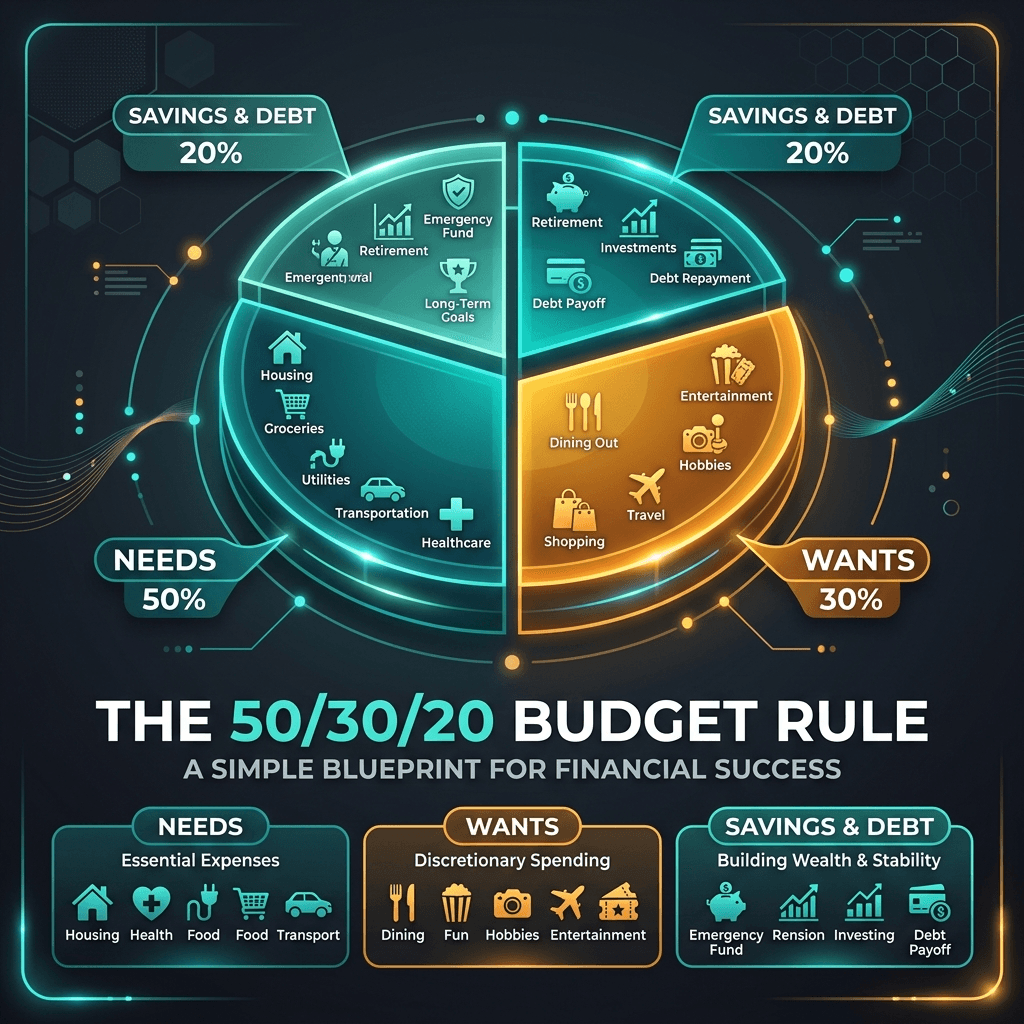
The idea is straightforward: split your after-tax income into three buckets. Half goes to needs, 30% to wants, and 20% to savings and debt repayment. No spreadsheet required. No category-by-category breakdown. Just three numbers.
But in 2026, with housing costs at historic highs and inflation still biting into grocery bills, does the original formula still hold up? This guide covers what the rule is, how to apply it, where it breaks down - and how to adapt it when life doesn't fit neatly into three percentages.
What Is the 50/30/20 Rule?
The 50/30/20 rule is a budgeting framework popularised by U.S. Senator Elizabeth Warren and her daughter Amelia Warren Tyagi in their 2005 book All Your Worth. The premise is simple: once you know your after-tax income, you divide it across three categories.
50% - Needs: Essential expenses you can't live without. Housing, food, utilities, transport to work, minimum debt payments, and basic insurance all fall here.
30% - Wants: Non-essential spending that improves quality of life. Dining out, subscriptions, holidays, hobbies, gym memberships, and upgrades you choose (but don't strictly need) live in this category.
20% - Savings and debt repayment: Money directed toward the future - emergency funds, retirement accounts, investment contributions, and paying down debt above the minimum.
The rule is designed for people who want a budget that's simple enough to stick to. It doesn't require you to track every coffee or log every transaction - just to understand which bucket your spending generally falls into.
How to Apply the 50/30/20 Rule - Step by Step
Applying the rule takes about 20 minutes the first time. After that, a monthly 10-minute review keeps you on track.
Step 1: Calculate your monthly after-tax income
Use your net take-home pay. If you're self-employed or have variable income, use a conservative average of the last three to six months. Include regular side income if it's reliable.
Step 2: Calculate each budget bucket
Multiply your net income by the three percentages. For example, on a $4,500 monthly take-home:
To split your take-home pay into these three buckets without doing the math by hand, run the figures through our free Percentage Calculator - it works out exactly what 50%, 30%, and 20% of your income come to in seconds.
Step 3: List your actual spending in each category
Pull the last two months of bank and credit card statements. Categorise every transaction into needs, wants, or savings. Be honest - streaming services are wants, not needs; a car payment for a car you need for work is a need.
Step 4: Compare actuals to targets
Are your needs under $2,250? Good. Are your wants creeping toward $1,800 instead of $1,350? That's your problem area. This comparison step is where the rule becomes genuinely useful - it shows you where the money is going, not just that it's gone.
Step 5: Automate the 20%
On payday, automatically transfer your savings portion before you spend anything. Once it's out of your current account, you stop treating it as available money.
→ Use our free Savings Calculator at GlobalUtilityHub to see exactly how your 20% grows over time - no sign-up needed.
Step 6: Review monthly, adjust quarterly
Life changes - income rises, rent increases, debts get paid off. Revisit the rule every quarter to make sure your percentages still reflect your reality.
50/30/20 Example: Real Numbers for a UK Household
Let's work through a real example using UK figures. A dual-income household in Manchester brings home £5,200 per month combined after tax.
Budget breakdown (50/30/20)
Actual needs breakdown
Actual wants breakdown
Savings and debt repayment
This household has £520 left over - which they can redirect to savings or allow as a buffer. The rule works well here because their housing costs are manageable relative to income.
The 50/30/20 Rule by the Numbers
| Monthly Take-Home | 50% Needs | 30% Wants | 20% Savings |
|---|---|---|---|
| $2,500 | $1,250 | $750 | $500 |
| $3,500 | $1,750 | $1,050 | $700 |
| $4,500 | $2,250 | $1,350 | $900 |
| $6,000 | $3,000 | $1,800 | $1,200 |
| $8,000 | $4,000 | $2,400 | $1,600 |
| $10,000 | $5,000 | $3,000 | $2,000 |
*Based on net (after-tax) monthly income. Use these as starting targets, not rigid limits. You can calculate custom targets using our percentage calculator.*
According to a 2025 NerdWallet survey, only 32% of American adults follow a formal budget. Of those who do, simpler frameworks like the 50/30/20 rule show significantly higher adherence rates than detailed category-by-category systems.
Common Mistakes to Avoid
Confusing needs and wants The most common error is reclassifying wants as needs to make the numbers feel better. An annual holiday is a want, not a need. A premium gym subscription is a want. A morning coffee habit is a want. Be ruthless with this distinction - your budget only works if your categories are honest.
Using gross income instead of net The rule runs on after-tax, take-home income. Using your gross salary will cause you to overestimate every bucket and underestimate your actual constraints.
Ignoring the 20% entirely When money is tight, the savings bucket is the first to get cut. This is exactly backwards. Even if you can only manage 5-10% at first, protect the savings allocation. The rule is a framework, not a cliff - flex the percentages, but never drop savings to zero.
Applying it without adjusting for high-cost cities In cities like London, San Francisco, Sydney, or Toronto, housing alone can consume 40-50% of take-home income. If that's your reality, a modified split - 60/20/20 or 65/15/20 - is more honest and more sustainable than pretending the original holds.
Treating it as permanent and fixed The 50/30/20 rule is a starting point. As income rises and debts clear, your savings percentage should grow. Think of it as a floor, not a ceiling.
The Bottom Line
The 50/30/20 rule isn't perfect for everyone - and it never claimed to be. But as a first framework for people who want a structured, sustainable budget without obsessing over every expense, it remains one of the most practical tools in personal finance.
The key adjustment for 2026: treat the 50% and 30% buckets as flexible, and treat the 20% savings allocation as non-negotiable.
Savings Calculator gives you the answer in under 30 seconds - try it free at GlobalUtilityHub to see how your 20% compounds over time.
Use our free Savings Calculator to apply what you have learned.
Open Savings Calculator →