
Mortgage Refinancing Guide: When It Makes Sense and How to Do It Right
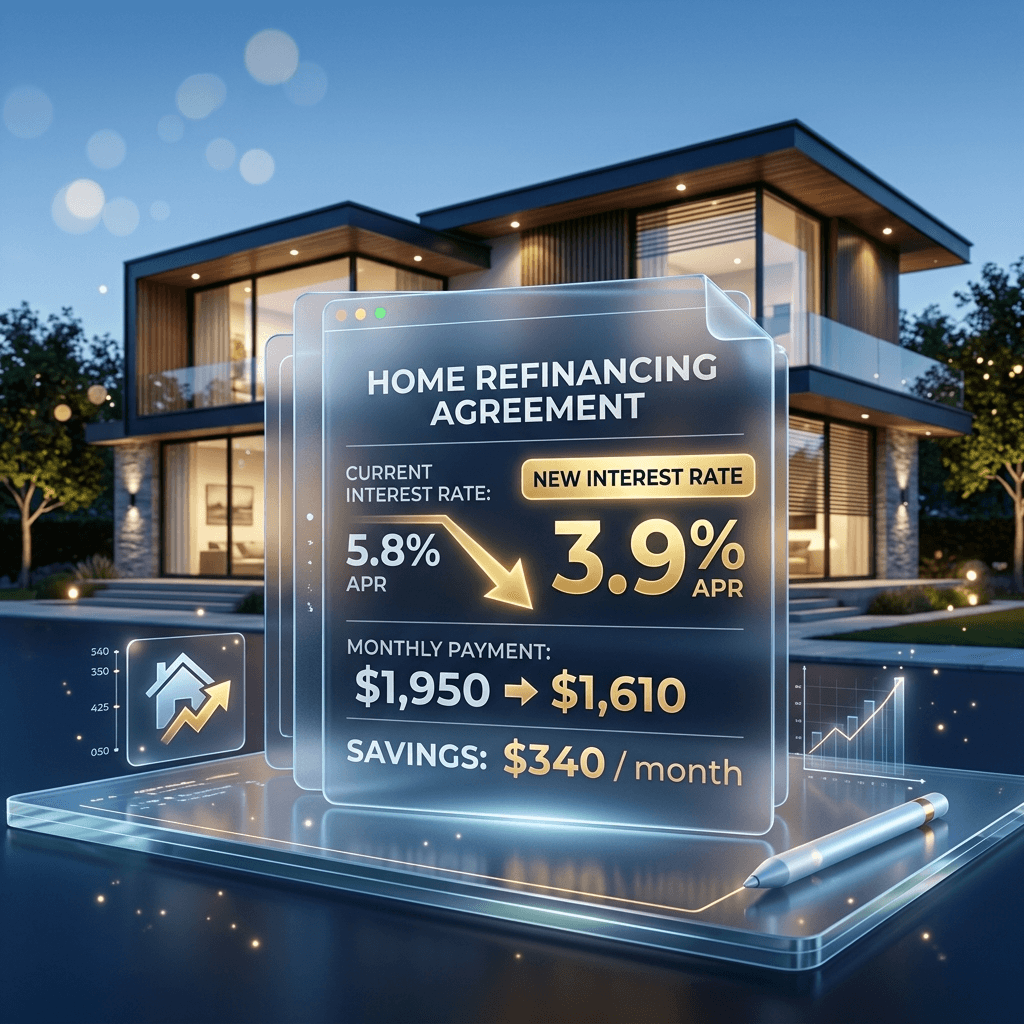
Refinancing your mortgage can save you tens of thousands of dollars - or cost you money if you get the timing wrong. The problem is that most homeowners either jump in too early, underestimate the closing costs, or don't calculate how long they'll actually stay in the home.
This guide walks you through everything you need to know about mortgage refinancing in 2026: when it makes financial sense, how to calculate your break-even point, what the process looks like, and the mistakes that could wipe out your savings before you see a single dollar of benefit.
What Is Mortgage Refinancing?
Mortgage refinancing means replacing your existing home loan with a new one - typically to get a lower interest rate, change the loan term, or tap into your home equity. When you refinance, your lender pays off the old mortgage and you start making payments on the new one.
There are two main types:
According to the Mortgage Bankers Association (2025), refinance applications account for roughly 30-40% of all mortgage activity in any given year - spiking sharply whenever rates drop even half a percentage point.
The goal of a rate-and-term refinance is simple: lower your monthly payment, reduce total interest paid, or both. The catch is that refinancing isn't free, and recovering those upfront costs takes time.
How to Calculate If Refinancing Is Worth It - Step by Step
The most important number in any refinancing decision is your break-even point - the month when your cumulative monthly savings finally exceed what you paid in closing costs.
Step 1: Find your current monthly payment
Write down your current monthly principal + interest payment. Don't include taxes or insurance - focus on the loan portion only.
Step 2: Estimate your new monthly payment
Plug your remaining loan balance, the new interest rate, and your chosen term into a mortgage calculator. The difference between this and your current payment is your monthly saving.
→ Use our free Mortgage Calculator at GlobalUtilityHub to get your new monthly payment instantly - no sign-up needed.
Step 3: Get your closing cost estimate
Refinancing typically costs 2%-5% of the loan amount. On a $300,000 loan, that's $6,000-$15,000. Your actual costs and the new rate you qualify for will depend on your current credit score. Ask your lender for a Loan Estimate document - they're required to give you one within three business days of your application.
Step 4: Calculate the break-even point
Break-even (months) = Total closing costs ÷ Monthly savings
If your closing costs are $7,200 and you save $200/month, your break-even is 36 months (3 years).
Step 5: Compare break-even to your planned stay
If you're planning to sell or move before you hit break-even, refinancing will cost you money. If you're staying put for years beyond that point, you could save significantly.
Step 6: Factor in the new loan term
A 30-year refinance on a mortgage you've already paid for 7 years resets your amortization clock. You may lower your monthly payment but pay more interest overall. Run the numbers on a 15- or 20-year term too - the monthly payment is higher, but total interest savings are dramatic.
Worked Example: The Johnson Family Refinances in 2026
Sarah and Mike have a $280,000 remaining balance on a 30-year mortgage at 7.1% interest, with 22 years left. Their current monthly payment (P+I) is $1,860.
Their lender offers them a 30-year refinance at 6.2% - a rate drop of 0.9 percentage points.
New payment at 6.2% on $280,000 (30 years): $1,710
Monthly saving: $150
Estimated closing costs: $6,200
Break-even: 6,200 ÷ 150 = 41 months (3.4 years)
They plan to stay in the house for at least another 10 years, so the refinance saves them:
But Sarah also notices that they've reset to a 30-year term, which means 8 more years of payments than their original plan. When they run the 20-year option instead - monthly payment $1,890 - the monthly cost is nearly the same as now, but they pay off the loan two years ahead of their original schedule and save $38,000 in total interest.
That's the power of running both scenarios before deciding.
Mortgage Refinancing by the Numbers
| Scenario | Original Loan | New Rate | Monthly Payment | Break-Even | Total Interest Saved |
|---|---|---|---|---|---|
| Drop from 7.1% → 6.2% (30yr) | $280,000 | 6.2% | $1,710 (-$150) | 41 months | ~$11,850 net |
| Drop from 7.1% → 6.2% (20yr) | $280,000 | 6.2% | $1,890 (-$30) | 207 months | $38,000+ over life |
| Drop from 6.8% → 5.9% (30yr) | $350,000 | 5.9% | $2,073 (-$185) | 38 months | ~$22,200 net |
| Cash-out refi at 6.5% | $220,000 → $270,000 | 6.5% | $1,706 | N/A | Equity accessed |
| Rate too small (7.0% → 6.85%) | $300,000 | 6.85% | $1,969 (-$31) | 226 months | Not worth it |
Note: Figures are illustrative. Use current rate quotes from your lender and verify with the Mortgage Calculator.
Common Mistakes to Avoid
Focusing only on monthly payment, not total cost
A lower payment feels good, but if you reset to a 30-year term after 10 years into your existing loan, you could pay hundreds of thousands more in interest over the life of the new loan. Always calculate total interest paid, not just monthly savings.
Ignoring closing costs
Some lenders advertise "no-closing-cost refinancing" - but those costs are either rolled into the loan balance (you pay interest on them) or offset by a higher rate. There's no free lunch. Get three Loan Estimate quotes and compare the APR, not just the rate.
Refinancing too frequently
Every time you refinance, you pay closing costs and reset the break-even clock. Refinancing twice in three years rarely makes mathematical sense unless rates have dropped dramatically each time.
Not locking your rate
Rates can change daily. Once you've decided to move forward, lock your rate for 30-60 days while your application processes. Floating the rate hoping for a better deal is gambling - and it can cost you.
Not shopping lenders
According to the Consumer Financial Protection Bureau (2025), borrowers who get at least three quotes save an average of $1,500 over the loan's early years. Your current lender is a starting point, not the destination.
The Bottom Line
Refinancing your mortgage isn't about chasing the lowest rate - it's about the math. Calculate your break-even point, factor in how long you plan to stay, consider the term reset, and always shop at least three lenders before committing.
A drop of even 0.75% on a $300,000 loan can save you over $100,000 in interest over a 30-year term - but only if the timing is right and you stay long enough to clear the break-even threshold.
Use our free Mortgage Calculator to apply what you have learned.
Open Mortgage Calculator →