
Closing Costs Breakdown: Every Fee Explained and How to Lower What You Pay
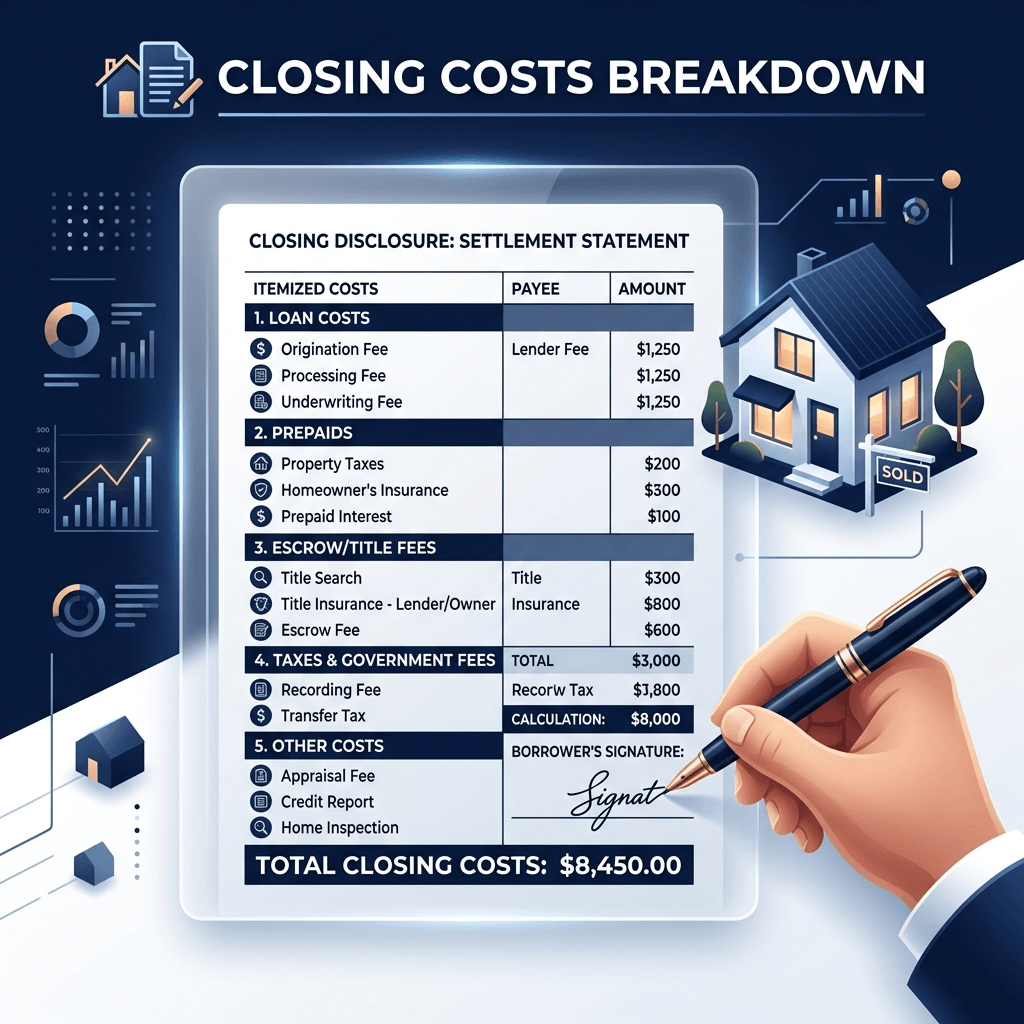
You've found the house, your offer has been accepted, and your mortgage is approved. Then the closing disclosure lands in your inbox - and the final page shows a closing costs total that's several thousand dollars higher than you expected.
This surprises almost every first-time buyer. Closing costs aren't a scam and they're not negotiable in the way that a car price is - but understanding every line item gives you real power to reduce what you pay. This guide breaks down every closing cost fee, shows you what's typical in 2026, and gives you practical tactics to cut the total before you reach the table.
What Are Closing Costs?
Closing costs are the fees and expenses you pay when a real estate transaction is finalised - or "closed." They include lender fees, third-party service costs, government charges, and prepaid expenses like homeowners insurance and property taxes.
According to CoreLogic (2025), the average closing costs in the US sit between 2% and 5% of the purchase price. On a $350,000 home, that's $7,000-$17,500. These fees aren't limited to home purchases; you will also encounter them when pursuing a mortgage refinancing, as the lender must still perform underwriting, title searches, and property appraisals.
Some of these costs are paid by the buyer, some by the seller, and some are negotiable. Understanding which category each fee falls into is the first step to managing what you owe.
There are two types of closing costs:
Every Closing Cost Fee Explained - Step by Step
Step 1: Review your Loan Estimate (LE)
When you apply for a mortgage, your lender must provide a Loan Estimate within three business days. This is a standardised 3-page document that lists all expected closing costs in three sections: Section A (lender fees), Section B (services you can't shop for), and Section C (services you can shop for - and potentially save on).
Step 2: Understand each fee category
Lender fees (Section A)
Third-party fees (Sections B & C)
→ Use our free Mortgage Calculator at GlobalUtilityHub to estimate your total loan costs including interest - no sign-up needed.
Step 3: Understand prepaid costs
These aren't fees in the traditional sense - they're expenses you're paying upfront to establish escrow accounts or cover the period between closing and your first payment.
> Pro tip: Closing near the end of the month minimises prepaid interest. Closing on the 28th instead of the 2nd can save hundreds.
Step 4: Compare your Closing Disclosure
Three business days before closing, your lender must provide the Closing Disclosure (CD) - a finalised version of the Loan Estimate. Compare them line by line. Section A fees cannot increase. Section C fees can change if you shopped those services yourself.
Step 5: Bring a cashier's cheque or arrange a wire
Personal cheques are typically not accepted at closing. Confirm the exact amount to bring within 24 hours of closing - wire fraud targeting home buyers is common, and you should verify wire instructions by phone directly with your attorney or escrow company.
Worked Example: Closing Costs on a $380,000 Home
Maria is buying a $380,000 home with a $304,000 loan (20% down payment).
| Fee | Amount |
|---|---|
| Origination fee (0.7%) | $2,128 |
| Appraisal | $500 |
| Credit report | $35 |
| Title search + lender's title insurance | $1,800 |
| Owner's title insurance | $850 |
| Attorney / settlement fee | $900 |
| Recording fees (state) | $250 |
| Prepaid homeowners insurance (12 months) | $1,400 |
| Prepaid mortgage interest (6 days) | $380 |
| Property tax escrow (2 months) | $820 |
| **Total closing costs** | **$9,063** |
As a percentage: $9,063 ÷ $380,000 = 2.39% - toward the lower end of the 2-5% range, reflecting a 20% down payment (no PMI), competitive lender fee, and shopping for title services.
Closing Costs by the Numbers: National Averages (2025-2026)
| Fee | Typical Range | Notes |
|---|---|---|
| Origination fee | $1,000 - $3,500 | Can be negotiated or waived by some lenders |
| Appraisal | $300 - $700 | Fixed by appraiser - shop early |
| Title search | $150 - $400 | Shop this (Section C) |
| Lender's title insurance | $500 - $1,500 | Required; price varies by state |
| Owner's title insurance | $400 - $1,200 | Optional but strongly advised |
| Attorney/settlement | $500 - $1,500 | Required in some states |
| Prepaid homeowners insurance | $800 - $2,500 | Based on coverage amount |
| Property tax escrow | Varies widely | 2-6 months depending on lender |
| Recording fees | $50 - $500 | Set by local government |
| **Total typical range** | **$7,000 - $17,500** | On a $350,000 home (2-5%) |
Source: CoreLogic, CFPB (2025). Figures vary by state, lender, and property type.
Common Mistakes to Avoid
Not reading the Loan Estimate carefully
The LE is a legal document, and the numbers on it are binding (or close to it) for most fees. Many buyers glance at the total and miss individual line items that are inflated, duplicated, or unnecessary. Read every line.
Forgetting about prepaid costs
Buyers budget for the loan fees but forget that they'll also owe several months of property taxes, a year of homeowners insurance, and prepaid interest at closing. These can add $3,000-$5,000+ to your cash-to-close number on top of the fees.
Not shopping for title services and settlement agents
Section C services on the Loan Estimate are ones you're allowed to shop for. Many buyers let the lender choose - but choosing your own title company can save $500-$1,000 in some markets.
Accepting origination fees without negotiating
If you have strong credit and a large down payment, you're a low-risk borrower. Ask your lender directly: "Can you reduce or waive the origination fee?" The worst they can say is no. According to the CFPB (2025), comparison shopping for lenders is the single most effective way to reduce closing costs.
Ignoring seller concessions
In a buyer's market or when the home has been sitting unsold, sellers may agree to cover some or all of your closing costs as part of the negotiation. This is called a "seller concession" and can be worth thousands. Ask your agent to include this in the offer.
The Bottom Line
Closing costs are unavoidable - but they're not fixed. Understanding every fee category, shopping for the services you can choose, negotiating lender fees, and timing your closing strategically can realistically trim $1,500-$4,000 from your total. If you want to avoid these upfront fees entirely in the future instead of refinancing repeatedly, a strong alternative is focusing on paying off your mortgage early.
Plan ahead: budget 2%-5% of the purchase price in addition to your down payment, review your Loan Estimate line by line, and compare at least three lenders.
Use our free Mortgage Calculator to apply what you have learned.
Open Mortgage Calculator →