
Fixed-Rate vs Adjustable-Rate Mortgage (ARM): Which Is Right for You?
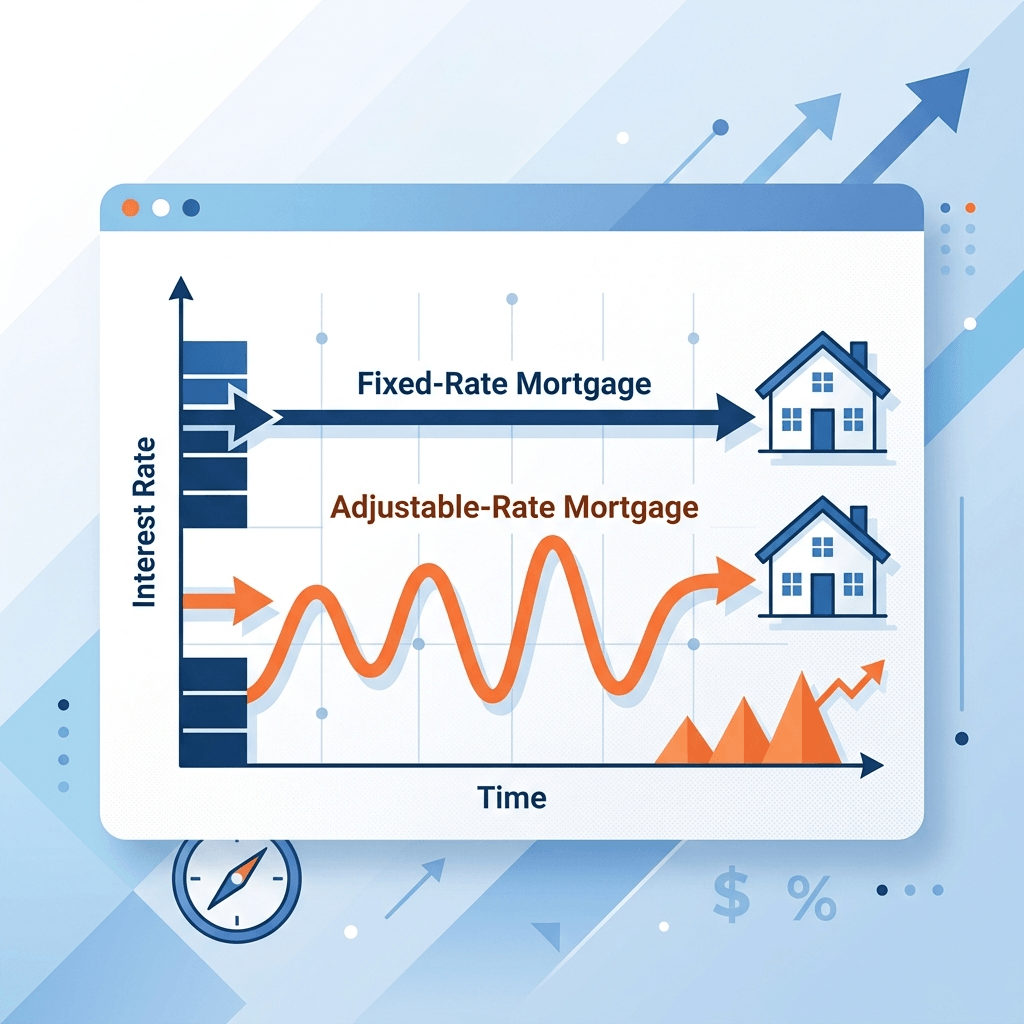
When applying for a mortgage, you will face one of the most consequential decisions of your home-buying journey: Should you lock in a fixed rate for the next 30 years, or take an adjustable-rate mortgage (ARM) that starts lower but can change later?
This decision is a direct tradeoff between certainty and initial cost. Choosing the wrong structure can cost you tens of thousands of dollars or, in the worst-case scenario, put you at risk of losing your home if payments adjust beyond what you can afford.
Here is a comprehensive breakdown of fixed-rate mortgages and ARMs, how adjustments and caps work, and a simple 3-question framework to help you make the right choice.
Fixed-Rate Mortgages: The "Set It and Forget It" Gold Standard
A fixed-rate mortgage is a loan where the interest rate stays exactly the same for the entire life of the loan - typically 15 or 30 years.
The Advantages:
* Absolute Predictability: Your monthly principal and interest (P&I) payment will not change by a single penny. Whether you are in Year 1 or Year 29, the payment remains identical. (Note: Your total monthly escrow payment may fluctuate slightly due to changes in local property taxes and homeowners insurance rates, but the loan payment itself is locked).
* Protection Against Rising Rates: If inflation spikes and market interest rates soar, your locked-in rate remains completely insulated.
The Disadvantages:
* Higher Initial Rate: Lenders charge a premium for the long-term rate guarantee. Fixed rates are typically 0.5% to 1.5% higher than the initial teaser rates offered on ARMs.
* No Benefit from Falling Rates: If market interest rates drop, your rate does not follow them down. To get a lower rate, you must manually go through a full refinance, which costs 2% to 5% of the loan amount in transaction fees.
Best for: Buyers planning to stay in their home for 7 to 10+ years, families who value budget certainty, and anyone buying in a low-interest-rate environment.
Adjustable-Rate Mortgages (ARMs): The Calculated Short-Term Strategy
An ARM is a loan where the interest rate is fixed for an initial period (usually 3, 5, 7, or 10 years) and then adjusts periodically based on current market interest rates.
ARMs are typically named with two numbers (e.g., a "5/1 ARM" or a "7/6 ARM"):
* The First Number is the length of the initial fixed-rate period in years.
* The Second Number is how often the rate adjusts after that initial period (e.g., "1" means once per year, "6" means once every six months).
The Advantages:
* Lower Initial Rate & Payments: The "teaser" rate is significantly lower than a comparable 30-year fixed rate. This can save you hundreds of dollars per month in the early years of the loan.
* Increased Buying Power: A lower initial rate improves your debt-to-income (DTI) ratio, which can sometimes help you qualify for a slightly larger loan amount.
The Disadvantages:
* Payment Shock Risk: Once the initial period ends, your rate and payment can increase dramatically if market rates have risen.
* Complexity: ARMs have multiple moving parts (indexes, margins, adjustments, and caps) that make them much more difficult to evaluate than simple fixed loans.
Best for: Buyers who know they will sell or refinance the home within 5 to 7 years (such as medical residents, corporate transferees, or starter-home buyers).
Side-by-Side Comparison: Fixed vs. ARM
*This table breaks down the core structural differences:*
| Feature | Fixed-Rate Mortgage | Adjustable-Rate Mortgage (ARM) |
|---|---|---|
| **Initial Interest Rate** | Higher (standard market rate) | Lower (often 0.5% - 1.5% below fixed) |
| **Monthly Payment** | 100% predictable; never changes | Changes periodically after initial period |
| **Market Risk** | None (fully protected) | High (subject to market spikes) |
| **Refinance Necessity** | Only if you want to capture lower rates | Highly likely before the initial period ends |
| **Complexity** | Extremely simple and transparent | Complex (requires understanding caps) |
| **Ideal Timeline** | 10+ years in the home | 3 - 7 years in the home |
How ARM Adjustments & Caps Work
If you are considering an ARM, you must understand how your rate is calculated and how "caps" protect you from unlimited rate increases.
When your ARM adjusts, the new interest rate is determined by adding two numbers:
* The Index is a benchmark interest rate that fluctuates with the market (most modern ARMs use the Secured Overnight Financing Rate - SOFR).
* The Margin is a fixed percentage added by the lender (typically 2% to 3%) that remains constant for the life of the loan.
If the SOFR index is 4.5% and your margin is 2.5%, your adjusted interest rate will be 7.0%.
Understanding Rate Caps (Your Insurance Policy)
ARMs are legally required to have interest rate caps, which limit how much your rate can increase. These are typically expressed as three numbers (e.g., 2/2/5):
How to Decide? Ask Yourself These 3 Questions
To make an informed decision, run through this simple three-step check:
If you are buying a "forever home" to raise a family, a fixed rate is almost always the correct choice. If you are buying a starter condo and plan to move in 5 years, a 7-year ARM is a highly effective tool because you will likely sell the home before the rate ever adjusts.
If the answer is no, you are taking an active gamble with home foreclosure. Never buy a home assuming rates *must* go down or that you will *definitely* be able to refinance before the adjustment period starts.
If a 30-year fixed is 6.5% and a 5/1 ARM is 6.0% (a 0.5% spread), the savings are rarely worth the long-term risk. If the spread is 1.5% or wider, the front-loaded savings become highly compelling.
The Bottom Line
Do not choose an ARM out of desperation to fit an otherwise unaffordable home into your monthly budget. Choose an ARM only if your timeline matches the fixed-rate period and you have a clear exit strategy (selling or refinancing) before the adjustments begin.
Calculate your exact payments under both scenarios using our free Mortgage Calculator.
Use our free Mortgage Calculator to apply what you have learned.
Open Mortgage Calculator →